Labs for Liberation Summer Institute Lecture Series

Labs for Liberation. Summer institute on disability and design. June 9-July 18, 2025. On the left is the Labs for Liberation logo, with a sun-shape made of computer circuits.

Dates: June 9-July 18, 2025. All sessions are online. ASL and CART available.

Summer Institute directors: Moya Bailey and Aimi Hamraie

Accessibility coordinator: Angela Stanley 

Funded by: The Mellon Foundation 

Overview

What does it take to design an accessible world? For decades, design education has approached disability through the limited parameters of accessibility codes and standards. Schools of architecture, design, engineering, computing, and others rarely extend beyond minimum requirements to consider interdisciplinary frameworks offered by the disability justice movement, feminist theory, critical disability studies, or Black studies. At the same time, students of humanistic and social science approaches to disability understand that our built and social environments shape how disabled people are treated. But these students rarely have opportunities to actually engage with design as a collaborative praxis for working towards a more accessible world. 

The Labs for Liberation Summer Institute on Disability and Design offers a collaborative, generative, theoretically-rigorous, and lab-based space for integrating accessibility theory and practice. Our goal is to create new conversations between critical disability studies and Black feminist disability approaches to design and technology. Participants will have opportunities to engage with experts in these fields in order to bridge many realms of thinking, knowing, and making. Building on the innovative protocols of the Critical Design Lab and the Digital Apothecary Lab, the summer institute will lay the necessary groundwork for new generations of designers and theorists to understand what it means to go “beyond the code” in accessible design. 

This Summer Institute is part of a broader project funded by the Mellon Foundation.

Lecture Series

The Labs for Liberation Summer Institute on Disability and Design will host six lectures and panel discussions throughout June and July on Mondays from 10am-12pm CST. These lectures are open to the public and require registration. Please note that you must register for each lecture you would like to attend. All lectures will have ASL and CART provided. If you have any other accessibility requests, please contact Angela Stanley.

June 16th: Technoableism, Cyborgs, and Infrastructure

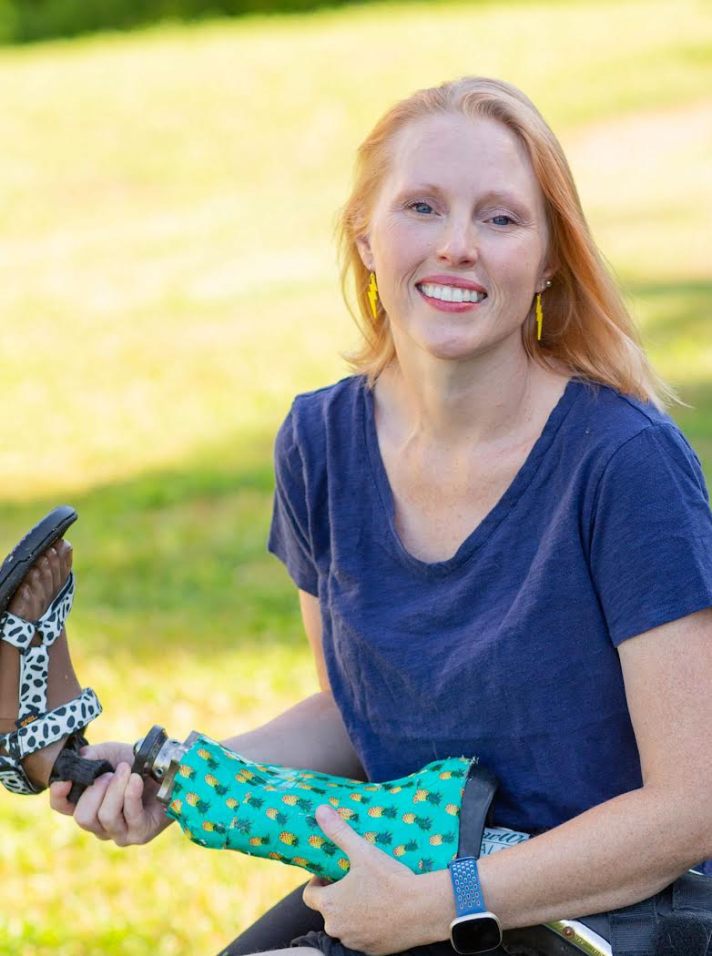
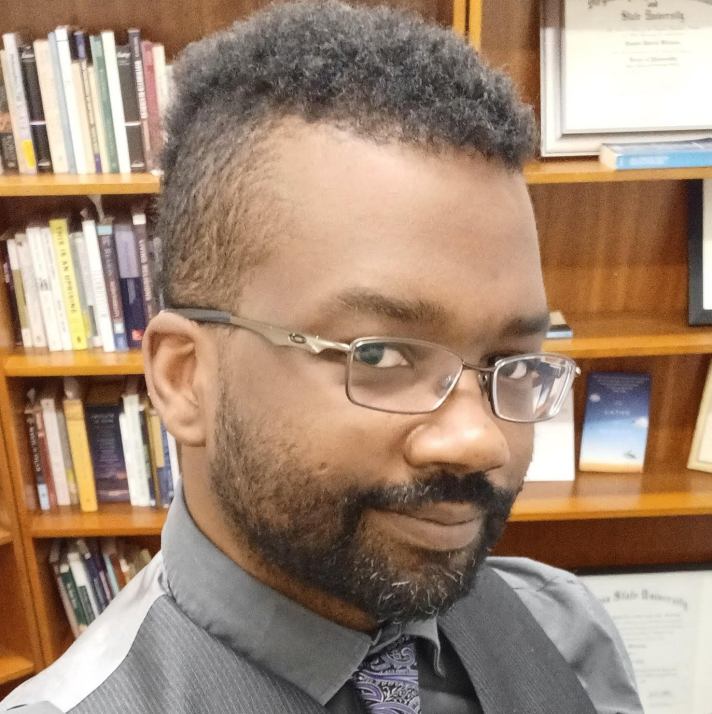
A lecture and panel discussion with Ashley Shew and Damien Patrick Williams. Learn more and register for the June 16th lecture here.

June 23rd: Design Friction and Access Washing

Lectures and discussion with Imani Barbarin and Sara Hendren. Learn more and register for the June 23rd lecture here.

June 30th: The Power of the Wild Disabled Idea

Lecture and discussion with Leah Lakshmi Piepzna-Samarasinha. Learn more and register for the June 30th lecture here.

July 7th: Resilience is a Social Practice

Resilience is a Social Practice. A Performance Lecture by Jeff Kasper with Commentary by Sasha Costanza-Chock. Learn more and register for the July 7th lecture here.

July 14th: Student Project Showcase

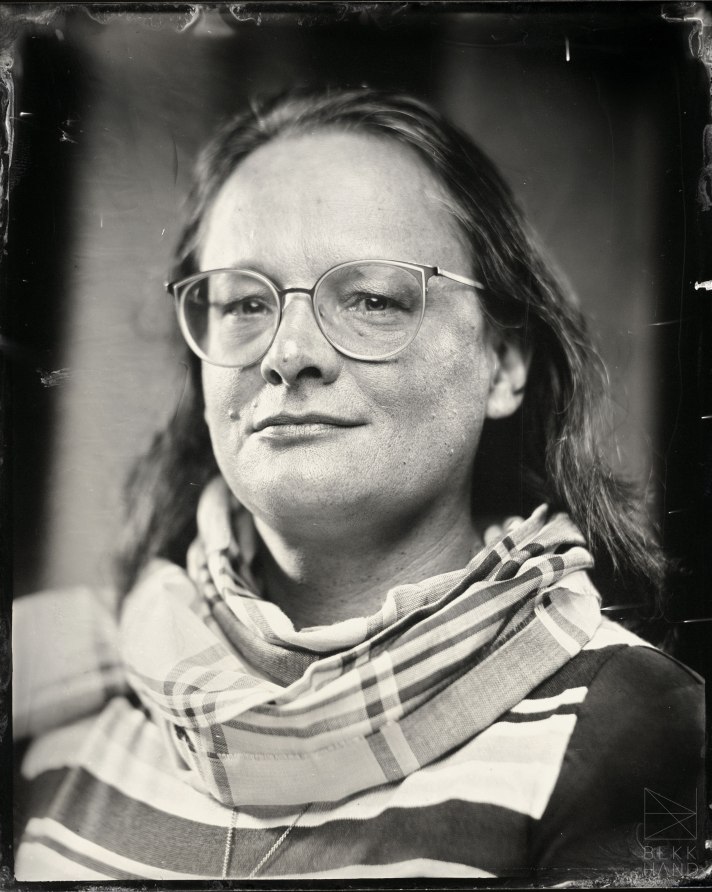
A presentation by the students of the design labs with commentary by Alex Hanna and Bess Williamson. Learn more and register for the July 14th lecture here.

Learn more about our speakers in our Summer Institute Announcement.

Building Community for a New Digital Migration

The Labs for Liberation fellows are exploring how ideas about disability and race can better inform how we think about design and technology. They will examine these intersections through blog posts throughout the year. In this year’s third blog post, Chelle Sands explores the concepts of “digital migration” and “digital travel,” offering a decolonial framework for community engagement in virtual spaces.

—-

When I began writing this blog post, I initially wanted to create a guide, “The Anti-Capitalist’s Guide to Digital Migration” as a response to the mass migration of social media users to Bluesky. When searching “digital migration,” you’ll probably find a lot of information around the transition from analog to digital broadcasting. You might even find researach on the ways in which migrants (in the context of immigration) use digital technologies to coordinate their movements to new places, ensure their safety and how that interplays with government management. I think that’s an important conversation to have, but for the purposes of the guide, I’m usi­ng “digital migration” to mean ­a different concept. When I talk about digital migration, I mean the movements we make to new places in the digital space. This can look like migration from one email provider to another, from one music streaming application to the next, but I’m particularly interested in our migration from social media conglomerates such as Meta and X. In the two decades they’ve existed, these platforms have been rife with issues around moderation biaswhite supremacist driven harassment and their owners leading the rise of digital fascism. I’m curious about how my definition of digital migration can be an empowerment tool; one that re-centers community as central to social media rather than profit and authoritarian politics. 

When I began my journey on the internet, I utilized a wide-range of technologies and spaces to interact with my friends, family and sometimes to meet to new people. If I were to map out how my journey has played out over the 18ish years I’ve utilized the internet in this way, it’d probably look something like: AOL chatroom → Bebo → MySpace → Facebook → Instagram → Tumblr → Twitter →  Mastodon. This journey isn’t complete, nor is it linear; there have been reroutes, returns, disruptions and mergers. Many of the choices in where I’ve landed are ones I thought I made of my own accord, but were heavily manufactured by the decisions of corporations whether that is due to one acquiring the other (in the case of Facebook acquiring Instagram), or fascists taking control over a platform (in the case of Elon’s acquisition of Twitter, now known as X, driving me to test out Mastodon). 

As I’ve deepened my technological curiosity and study of how Big Tech has furthered capitalism, colonization and imperialism, I’ve grown weary of opportunistic corporations forcing my digital travel. Because of this, I needed to shift gears. So, this post isn’t going to be a guide, because when I tried to write a guide, I returned to an unhelpful hyper-fixation: which platform is the best for those who want to opt-out of capitalist/colonialist/fascist nature of social networking. Instead, this blog post is a reflection on the work I’ve done throughout this fellowship to build grassroots community in the digital realm.  My work seeks to provide infrastructure for reflecting on our digital migration patterns in order to criticize the social, political and economic forces that have guided digital travel since the start of the internet in an effort to provide a community-based, decolonial framework for engagement and communication in the digital space. 

How I Entered This Work:

In winter 2023-2024, I joined the School of Poetic Computation as a student for their Solidarity Infrastructures class taught by Alice Wong, Oren Robinson and Meghna Mahadevan. Explained on the class website,

“In this class, we will explore concepts like the slow web, organic Internet, right-to-repair, data sovereignty, minimal computing and anti-computing. Get to know how community tech and organizing go hand-in-hand through real-world case studies. Learn about the creative applications and underlying ideologies of various open source tools and network topologies. Tune into signals of radical communication beyond colonialist legibility. Along the way, we aim to challenge the technocapitalist worldview, breaking the dichotomy of “high” and “low” tech in favor of a needs-based approach that centers collectivist values and the Earth.

Over the course of the class, participants will develop technical skills for running a situated server practice and learn from each others’ experiences.”

Solidarity Infrastructures provided a great foundation for learning beginner concepts in participating and developing an internet that is centered on community and solidarity. Learning the technical skills was something I picked up in bits throughout the class duration, but more importantly, I learned about real-world applications of using this technology to deepen relationships between community, technology, land and time. 

For this class, we were challenged to develop a server-based project. Initially, I wanted to find the “perfect” application that would host my circle of friends in an effort to migrate them from Big Tech applications like Instagram and TikTok to something that better protected our data, and allowed us to engage with technology outside of an anti-capitalist framework. At the time, I was recording an audio-blog called Media Club. This is/was a space for lovers of mixed-media who desired a space to intentionally engage content from a liberatory point of view. This was something I wanted to share across my communities, as something that often tied us together was our love for television and film! One of my first server experiments involved building a Castopod server that would turn my audio recordings into a Mastodon-like social platform. It was really cool to experiment with, but once it was up and running, I realized I had no idea how to convince my friends to join yet another platform, that was also kinda difficult to understand. And I ran into this problem with each platform I experimented with. 

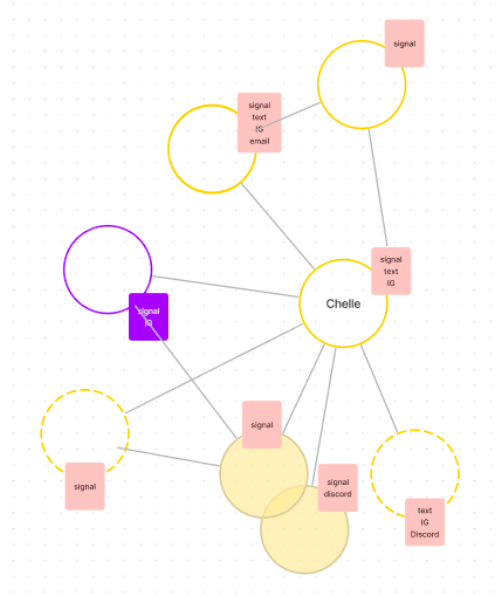
So, I shifted gears. My project became less about which platform would be the Trojan horse that would break down the walls of Big Tech social networking, and it shifted into a more personal reflection of who my community is and what kind of infrastructure we have built amongst each other. The finished project is this blog post hosted on the class website entitled, “am i… a server? d[-_-]b”. I took to using a tool called podmapping to ground myself in really seeing who makes up my community. From my blog post, I wrote, 

“so i’ve secured the hardware, stood up the server, downloaded the applications, migrated my content… how do i get folks to interact with / migrate to / even just look at m3diaclub.nohost.me? coming into this class, i had a big questions around migration. with so many (including my community!) operating within the walled gardens of Big Social Media, what does it take to get folks to take the leap to something new, somewhere where not too many of us are? in the organizing community, I see the critiques stream in of Elon’s takeover of Twitter, concerns of shadow-banning on facebook and instagram… but we are still there (myself included). and this is how I started forming the theory that in my community, it takes a foundation of political alignment and vulnerability in our relationship to migrate together. political alignment in the sense that we are fed up enough about our current digital platforms that we be moved to action. And vulnerability meaning that we cultivate a space to make mistakes and navigate the uncertainty of new tech together.”

I made multiple versions of this map controlling for political alignment and vulnerability, and correlated this to infrastructure maps of centralized, decentralized and distributed networks. This would inform who I would choose to work with on future iterations of this technology build and what that build what look like. 

Picking Up Where I Left Off:

After the conclusion of Solidarity Infrastructures, I knew that I wanted to dig deeper into this work! The technology was really fun to play with, and I wanted to build upon the concepts of intentionally engaging my community in order to co-create a digital world we can communicate and play in without being under constant surveillance and contributing to the expansion of digital colonialism. Getting accepted into this fellowship has been a critical step, as it has given me time and space to play with these concepts while on a small work sabbatical. 

In alignment with my work and time off, I came across a portable network kit workshop facilitated by Community Tech New York (CTNY). The 4-day opportunity included flying out to NYC for training on technical skills-building, collective organizing and resource sharing. CTNY describes a portable network kit (PNK): 

“The Portable Network Kit (PNK) is a wireless network in a suitcase that helps people understand how to build their own mini-internet – and with it, how the internet works and might be owned and governed more equitably. Originally conceived as a network repair kit for Resilient Networks for RISE: NYC in New York City, the kits were repurposed to work both as a teaching tool and as an emergency standalone wireless network. PNKs consist of off-the-shelf hardware and open-source software housed in a waterproof, battery-powered, solar-enabled kit. The kits can be used to connect to an existing internet connection or offline as a local wireless networking system, complete with its own server, chat service, and document editor.

PNKs are not a product – we don’t sell them off-the-shelf. CTNY uses PNKs when training community members in network development and deployment, giving them practical hands-on experience that can serve as a springboard for building their own networks with in-person or remote learning support.”

It felt serendipitous to come across this opportunity, and so I immediately applied, and was accepted! My project work has largely been informed by my work as an organizer, working to build a local Black Atlanta solidarity economy and creating a culture of political education that brings history and theory to our community’s lived struggles. A huge part of that struggle is the construction of a Cop City that not only increases Atlanta Police Department’s surveillance and incarceration of civilians and especially organizers, but threatens Atlanta’s ecology through the destruction of 381 acres of Weelaunee Forest, often described as the lungs of Atlanta and protecting the city in the face of climate disaster. A huge portion of the movement to Stop Cop City, has included pressuring the donors and supporters of Atlanta’s Police Foundation (APF) which has spearheaded the Cop City project to drop their contracts in an effort to defund its constructions. The relationships that contribute to this project form a complex web of direct and indirect support, and AT&T has been identified as a corporation that is enmeshed. I asked myself, how can we meaningful divest from companies that are intent on funding the institutions that are furthering our oppression? How can we, instead, build a digital community that is founded on solidarity with each other and the land? 

Knowing AT&T’s culpability in a project detrimental to the liberation of Black Atlantans and wanting to merge my interests of building a solidarity economy and liberatory tech, I recognized the opportunity to build community networks as essential to the development of my project, The Digital Village. Here was a chance to not only build upon my technical skillset, but also to look back at my podmap and choose 3 folks who fell along those lines of political alignment and vulnerability to learn together!  Until then, my server work had felt a bit solitary. Attending this workshop was a chance to expand my community of tech-workers who were interested in re-shaping how we live life online, even if we weren’t always confident in our technical capabilities. But that was the point: to cultivate our technological imaginations, to experiment, fail, try again, learn and teach others. We’re building a community that acknowledges the necessity of community tech and re-building our ability to learn with the technology around us. 

Since attending this workshop, I’ve built deeper relationships with the community whom I embarked on this endeavor with. We’ve exchanged ideas, learned foundational knowledge and shared dreams of where this work would take us. We brought back our PNKs, stood them up successfully after re-familiarizing ourselves with the technology, tested the range of the connection and created a project plan to build a community resource map and a website for our organization. We’ve ideated on how we want our community to engage with the server, started building relationships with orgs who may want to contribute to the project and set a goal for when we would host our first Discotech – a space for community to come learn about the use of the PNK! 

Building on my Digital Political Theory

When I built out the proposal of this project, I wrote: 

“The Digital Village is the digital manifestation of the connections + relationships we maintain in the physical realm. We are taking lessons from the realities of and responses to the pandemic. Sometimes, it is inconvenient and unsafe to be together in person, but there is still desire to remain connected. Creating a platform that addresses this need while remaining as independent as possible from the digital-capitalist and digital-fascist supply chain is essential to our collective survival. 

The Digital Village seeks to operate outside the larger digital world as a means of protecting our privacy, practicing hyper-local community building and moving beyond digital spectacle as a means of surviving capitalism and fascism. as such, this project will explore decentralization of digital platforms, utilizing private and secure digital resources, federated social networking, and practices in an attempt to disrupt the digital-capitalist and digital-fascist supply chain to make a lasting impact that disrupts Big Tech, we also seek to operate with the larger digital system by offering research, work, art and Inspiration to those who share similar values systems and are seeking to build their own village and survive the current world.” 

I work to build on those anti-capitalist, anti-fascist and digital justice foundations as I continue my personal political development. Lately, I feel inspired by the work of decolonial feminists, past and present, who actively work to dismantle the systems of oppression not just on Turtle Island, but across the world and particularly in the Global South. Wanting to dig deeper into this topic as a means of continuing to shape The Digital Village towards a liberatory future, I picked up the book A Decolonial Feminism written by Françoise Vergès and translated to English by Ashley J. Bohrer. The book grapples with the ways in which feminism has been co-opted by the forces they seek to dismantle. Vergès argues that in order to truly fight against patriarchy, feminists must stop being proponents of the capitalist, imperialist, racist and colonialist systems that work alongside it. In the last chapter of the book, Vergès writes: 

“This brings me to the question that I would like to put at the heart of decolonial feminism: who cleans the world? How can we understand the relationship between capitalism as material and toxic waste producer, and its production of human beings seen as disposable? How is the outsourcing of waste invisibilized? How do we put our solidarity with care workers and cleaning workers into practice?” 

As we continue to build out our portable network, I’ve been thinking a lot about what it would take to maintain the network once it’s running and available to community. How do we maintain availability to repair the network, when it inevitably goes down, when each of us already have full-time jobs? Can we build a culture of slowness into this network to resist the expectation of speed and constant availability that capitalism promotes? Should we need to retire the network, how can we give its parts the opportunity for new life? What relationships do we need to build across the Global South to ensure that the people, land and minerals used to create this technology are cared for and in balance? All of these questions about digital maintenance and repair come to me as a compliment to Vergès’ questions regarding decolonial feminism, particularly because each of us building this network are Black, queer femmes who have had an expectation of producing care work as unpaid labor at multiple points in our lives and wish to disrupt the systems that enable exploitation. If The Digital Village is an extension of our physical selves and is also meant to reshape how we live life online, we must consider these questions lest we project onto our server the same colonial and patriarchal systems. 

These questions in mind, my hope is that, as we build out our network of community tech, that we continue to be specific by interrogating and defining our community. In my opinion and experience, it is a habit of organizers (myself included) to treat “community” as nebulous – no names needed, and so our “organizing” often excludes ourselves from the big picture. In working towards specificity, we center ourselves, the Black, queer femmes architects, and those connected to us so that we can interrogate how our behaviors contribute to the colonial project, and work against it. As the ones taking on the challenge of “cleaning the (digital) world”, we have the opportunity to build a foundation of digital maintenance as care work that is visible, compensated and/or reciprocal (in the spirit of solidarity economy). In a socio-political environment that seeks to romanticize care work as inherently good and virtuous, I hope that we treat maintenance and care work for what it often is – labor – so that we can work towards a digital gathering place that reshapes how we relate to each other as care workers and laborers and spread that labor amongst those who distance themselves from the role. As Shannon Mattern wrote in their journal article, “Maintenance and Care”,

“If we apply “care” as a framework of analysis and imagination for the practitioners who design our material world, the policymakers who regulate it, and the citizens who participate in its democratic platforms, we might succeed in building more equitable and responsible systems. 42 We should also remember that the preservation of our world — the human one — is sometimes at odds with caring for the ecological context. Perhaps not every road should be repaired. Geographer Caitlin DeSilvey encourages us to embrace entropy within the built world, to ask ourselves for whom we engage in preservation, and to consider cultivating an acceptance of “curated decay” where appropriate. 43

Building a decolonial feminist theory into digital justice work has reframed my role in this project. Working in the tech industry conditioned me to minimize my identity as a marginalized laborer to be about proving my value through getting the product working in order to make the deadlines of the corporations I served. Taking a step back from that space has allowed me to bridge my interests in digital technology and my political work. I know now that my role is to facilitate an environment where my community and I can cultivate our technological imagination, bridge this work across borders and contribute to building a world where we cultivate balanced relationships between people, land and tech. I’m excited to continue on this journey and see where our imagination takes us.  

To Continue Researching: 

How Black Maroon History can Inform Digital Maroonage 
Researching alternatives to extractive mining + how they inform our project

  • Coop vs. artisanal mining – lithium and cobalt 
  • Regenerative Mining Practices
Sign up to receive email alerts when we post!

Announcing Labs for Liberation Summer Institute on Disability and Design!

Labs for Liberation. Summer institute on disability and design. June 9-July 18, 2025. On the left is the Labs for Liberation logo, with a sun-shape made of computer circuits.

Dates: June 9-July 18, 2025. All sessions are online. ASL and CART available.

Summer Institute directors: Moya Bailey and Aimi Hamraie

Accessibility coordinator: Angela Stanley 

Funded by: The Mellon Foundation 

Overview

What does it take to design an accessible world? For decades, design education has approached disability through the limited parameters of accessibility codes and standards. Schools of architecture, design, engineering, computing, and others rarely extend beyond minimum requirements to consider interdisciplinary frameworks offered by the disability justice movement, feminist theory, critical disability studies, or Black studies. At the same time, students of humanistic and social science approaches to disability understand that our built and social environments shape how disabled people are treated. But these students rarely have opportunities to actually engage with design as a collaborative praxis for working towards a more accessible world. 

The Labs for Liberation Summer Institute on Disability and Design offers a collaborative, generative, theoretically-rigorous, and lab-based space for integrating accessibility theory and practice. Our goal is to create new conversations between critical disability studies and Black feminist disability approaches to design and technology. Participants will have opportunities to engage with experts in these fields in order to bridge many realms of thinking, knowing, and making. Building on the innovative protocols of the Critical Design Lab and the Digital Apothecary Lab, the summer institute will lay the necessary groundwork for new generations of designers and theorists to understand what it means to go “beyond the code” in accessible design. 

This Summer Institute is part of a broader project funded by the Mellon Foundation.

Lecture Series

The Labs for Liberation Summer Institute on Disability and Design includes a six-week series of free, online, and accessible programming offering lectures and panel discussions. Open to the public. CART and ASL available.

Our lecturers will include:

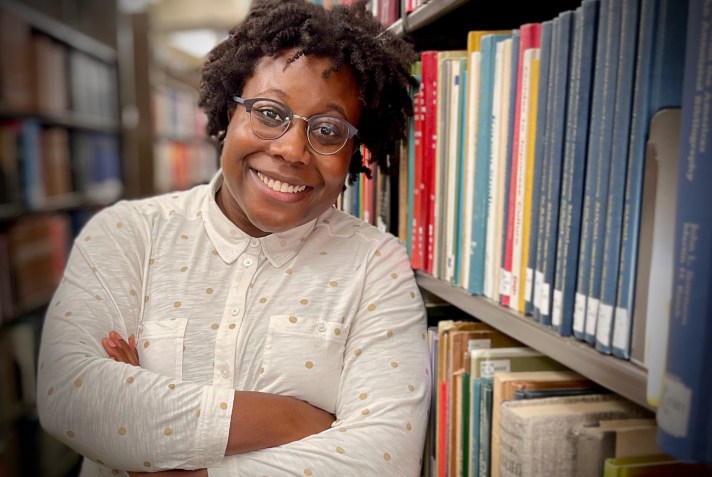
Dr. Bailey, a Black androgynous person with short natural hair, wearing glasses a white shirt, smiling and leaning against a library bookshelf.

Moya Bailey, author of #Hashtag Activism and Misognynoir Transformed, director of the Digital Apothecary Lab, disability justice organizer

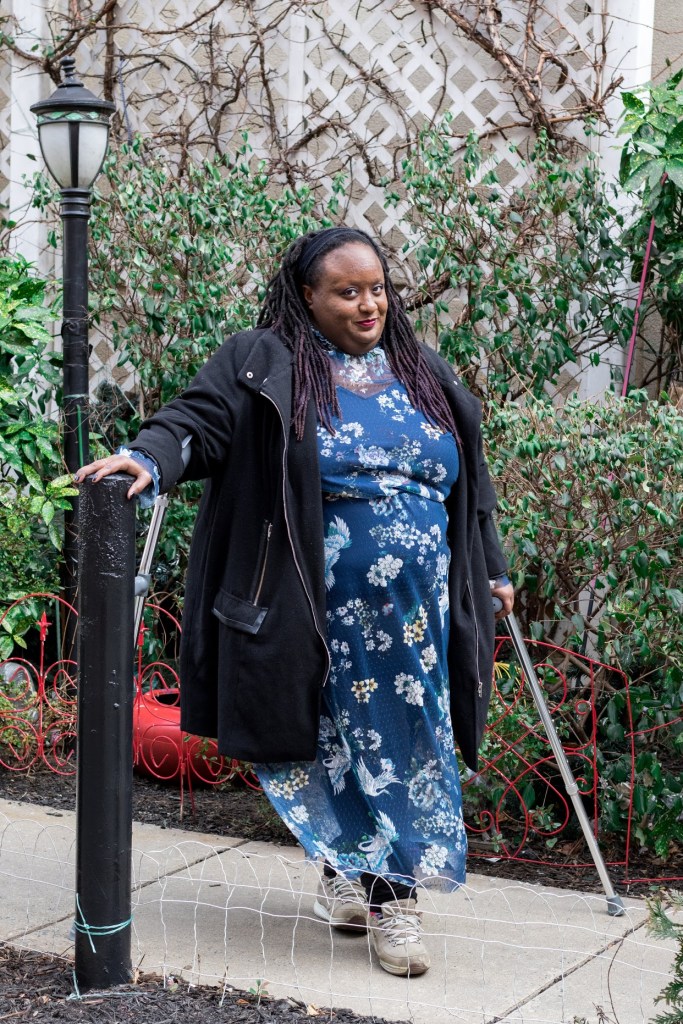
Imani Barbarin in a blue floral dress, black jacket, and sneakers, stands outside on a sidewalk, crutches on either side.

Imani Barbarin, Disability rights and inclusion speaker, blogger, and content creator (@CrutchesAndSpice) #ThingsDisabledPeopleKnow

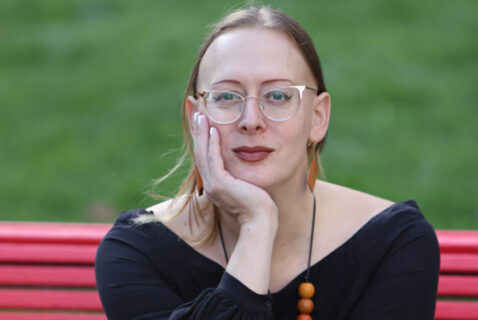
Headshot of Sasha Costanza-Chock, a nonbinary trans* femme sitting on a bench with their face resting on their hand.

Sasha Costanza-Chock, Ph.D. (she/her or they/them) is a researcher and designer who works to support community-led processes that build shared power, dismantle the matrix of domination, and advance ecological survival. They are a nonbinary trans* femme. Her book Design Justice: Community-Led Practices to Build the Worlds We Need is freely available at design-justice.pubpub.org.
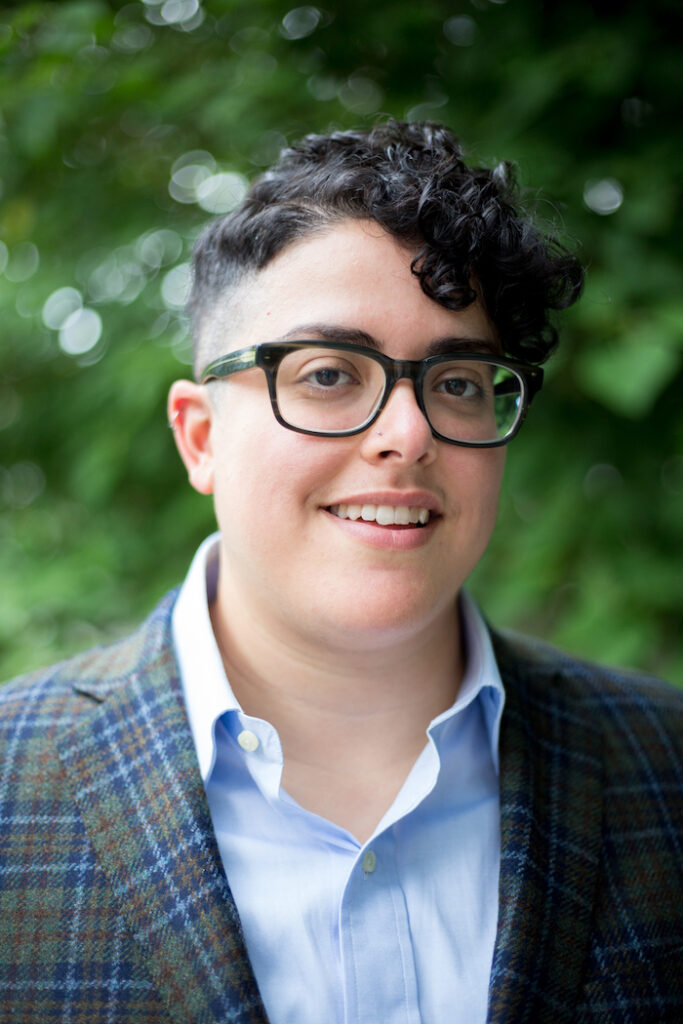
Aimi Hamraie, an olive-skinned Iranian person with short dark curly hair, smiles at the camera. They wear rectangular glasses and a blue button-up shirt. Behind them is a blurry green background

Aimi Hamraie, author of Building Access and the “Crip Technoscience Manifesto,” director of the Critical Design Lab, and southern disability justice organizer.

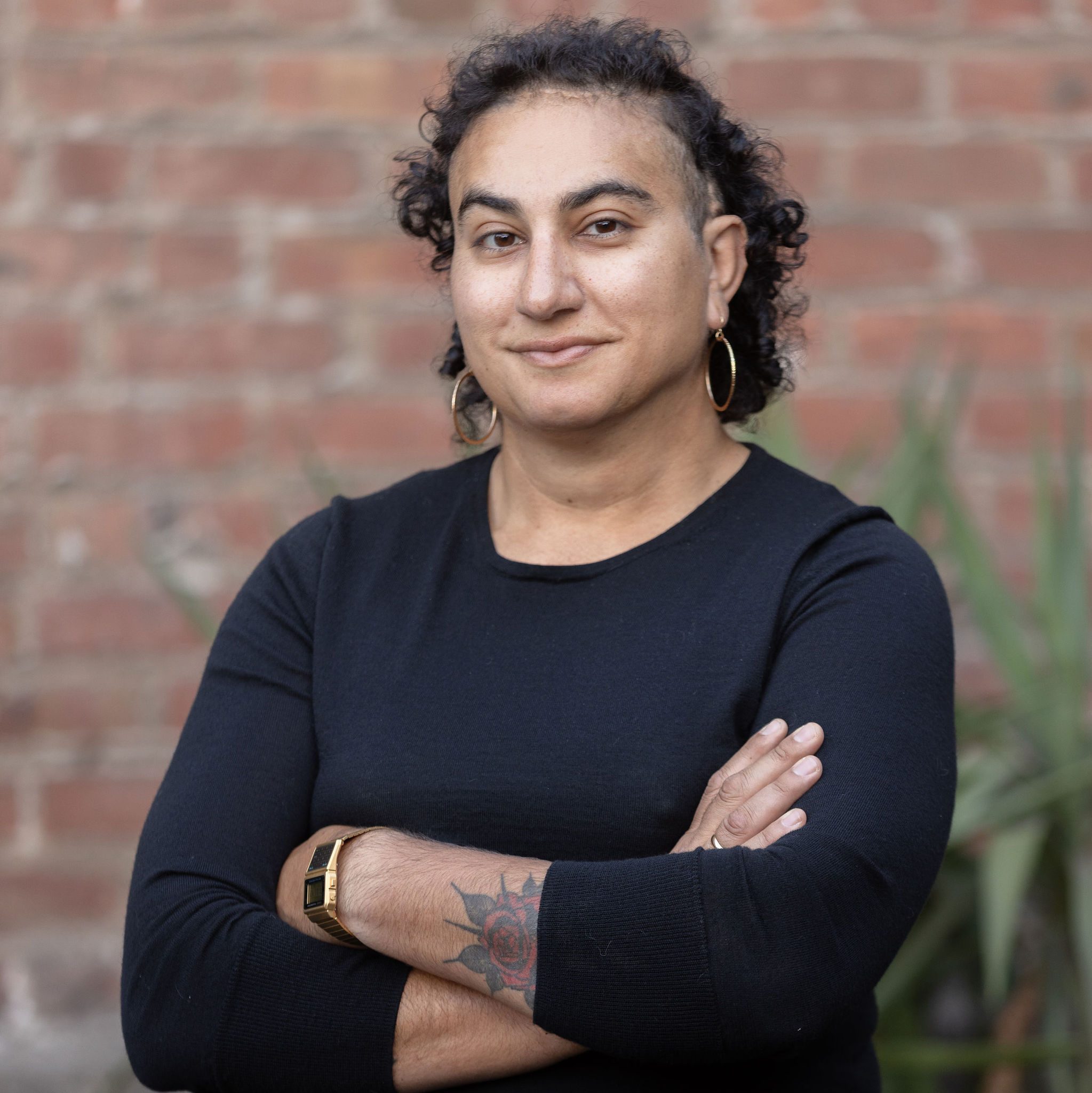
Alex crosses her arms and looks at the camera, wearing a black shirt and grey patterned skirt, along with gold hoops.

Alex Hanna, sociologist of race, gender, and class inequality in computational technologies, author of The AI Con, Director of Research at the Distributed AI Research Institute (DAIR), and co-host of the Mystery AI Hype Theater 3000 series. 

 Sara Hendren, a middle aged woman with shoulder-length brown hair and wearing a cream top, smiles at the camera.

Sara Hendren,  author of What Can a Body Do? How We Meet the Built World and Associate Professor of Art + Design and Architecture at Northeastern University.

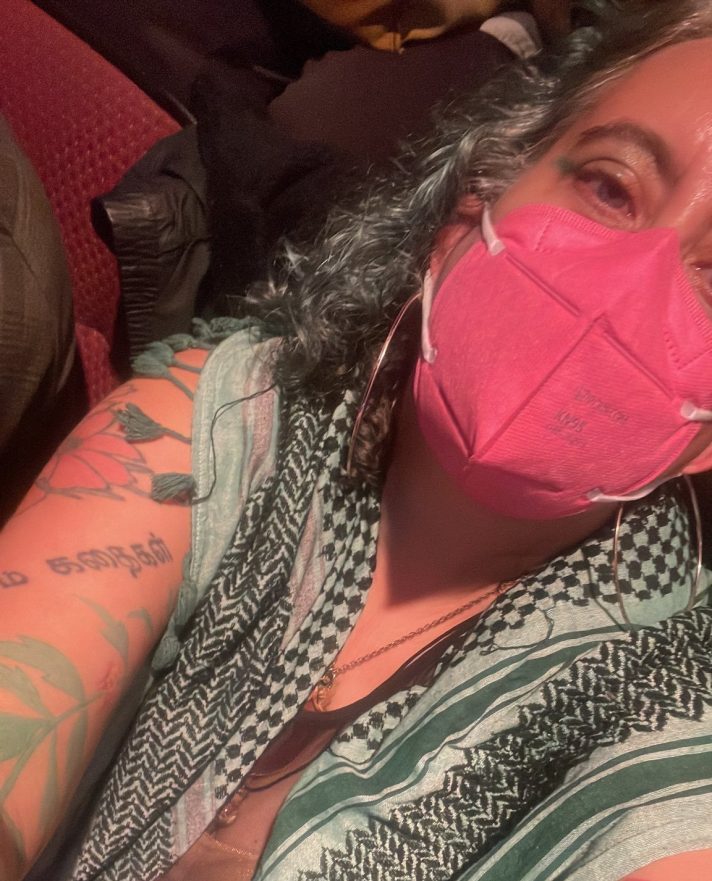
Leah wears a pink mask and a black, white, and green kuffiyeh, holding the camera up at an angle from above. Their arms are tattooed and they have black and white hair.

Leah Lakshmi Piepszna-Samarasinha, Burger/Tamil Sri Lankan, Irish and Galician writer, disability and transformative justice movement worker/structural engineer and older cousin/ untie, the author or co-editor of ten books including Care Work, The Future is Disabled, Tonguebreaker, and Dirty River.

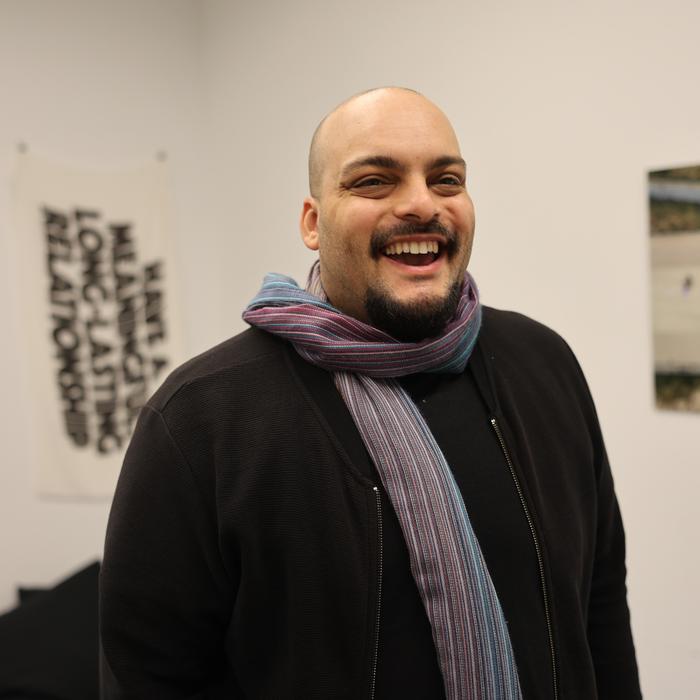
Jeff stands in a gallery, and smiles at the camera. He is wearing a purple-blue-grey scarf and a black shirt.

Jeff Kasper, editor of More Art in the Public Eye, creator of wrestling embrace and other disability arts projects, and Assistant Professor at University of Massachusetts-Amherst.

Ashley Shew, a white woman with reddish hair holds a leg prosthesis and smiles at the camera, outdoors on a pretty day.

Ashley Shew, a philosopher of technology and author of Against Technoableism.

Self-portrait of a smiling Black man with natural hair shaved on the sides and long in the center, a beard, and grey square-frame glasses, wearing a silver-grey pinstriped waistcoat and a dark grey shirt with a purple paisley tie, and black jeans; bookshelves filled with books and framed degrees are visible in the background

Damien Patrick Williams, Assistant Professor of Philosophy and Data Science at the University of North Carolina at Charlotte and author of the chapter “Disabling AI: Biases and Values of Artificial Intelligence.” in The Handbook on Ethics of Artificial Intelligence.

A grainy black and white, tintype image of Bess Williamson, a white middle-aged woman with dark hair and glasses, wearing a mix of stripes and plaids.

Bess Williamson, design historian, author of Accessible America, Associate Professor of Design Studies at NC State University.

Design Labs

*Applications are now closed*
The Labs for Liberation Summer Institute on Disability and Design includes a six-week funded, immersive, online design lab experience grounded in disability justice principles and practices for select participants who are training* in:
  • Design and other creative fields (including architecture, urban design and planning, graphic design, industrial design, human-computer-interaction, visual arts, social practice, performance, coding, and others) AND/OR 
  • Critical humanities and social science fields with an interest in disability studies (including critical disability studies, Black studies, science and technology studies, gender and sexuality studies, critical ethnic studies, American studies, media studies, Sociology, Anthropology, Educational Studies, and others) AND/OR
  • Activism, organizing, facilitation, and arts-based approaches (either focusing on disability justice and culture or wanting to learn more) 

*The design lab opportunity is for those who are still developing their skills and knowledge, whether through formal education or other learning pathways. This includes undergraduate, graduate, and professional students, as well as individuals without academic affiliations who are actively pursuing a course of study (i.e. facilitator training, movement strategy and organizing, or other areas of practice.) We welcome applicants at various stages of learning and development, including those transitioning into a new field. This program is not for those who are already established experts in their fields.

Our lab instructors include: 

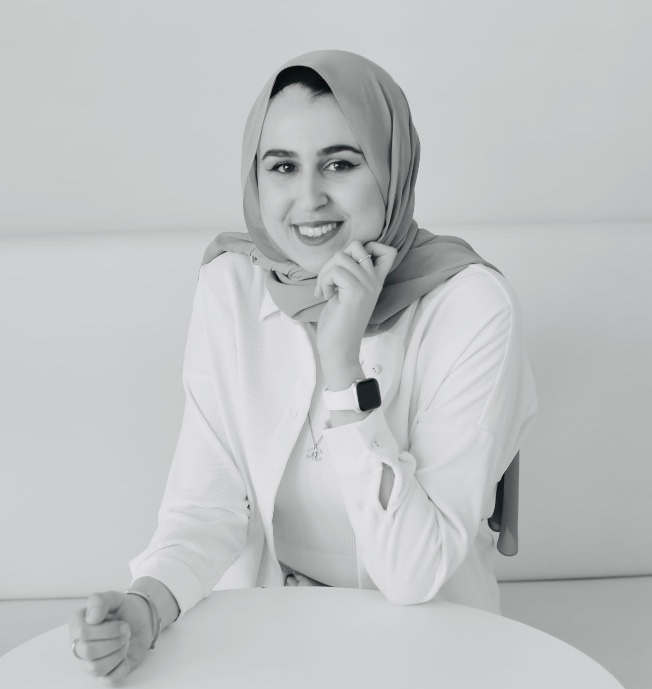
A black and white headshot of Jumanah Abbas wearing a white shirt and a grey head scarf and partially smiling at the camera. in an empty coffee shop.

Jumanah Abbas, architect and curator whose critical mapping and writing projects include “Mapping Memories of Resistance: The Untold Story of the Occupation of the Golan Heights,” “I Had Come from the Sea” (in collaboration with the Palestinian Museum), and publications in Arab Urbanism, Failed Architecture, New Generations, and others. 

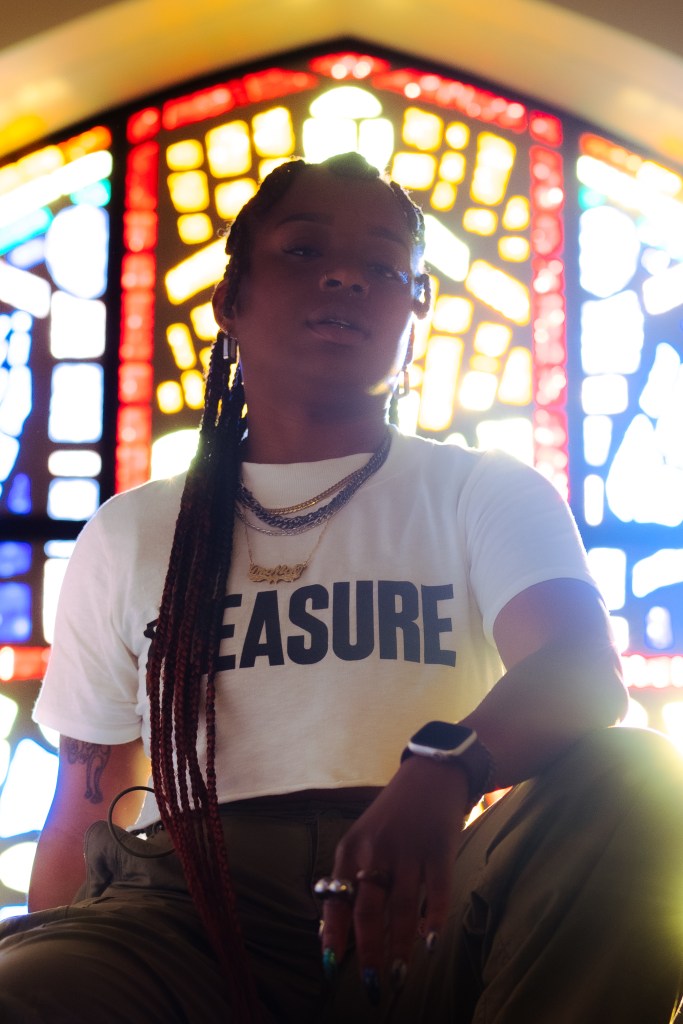
This image features a brown-skinned, non-binary person standing confidently in front of a vibrant stained-glass window. The lighting from the window casts a warm, almost halo-like glow behind them. They have long braids and are wearing a white t-shirt that prominently reads "PLEASURE" in bold black letters. The person has multiple necklaces, including one with a nameplate that says “dr. nick.” They are also wearing a smart watch and various rings, adding a stylish touch to their look. Their posture exudes confidence, and they appear calm and grounded. The stained-glass window in the background adds a spiritual, almost ethereal element to the photo. The overall vibe is both powerful and reflective, merging personal style with a sense of deep meaning.

Nick Alder, creative co-conspirator, healing + liberation spacemaker + community designer, pre-licensed psychologist, founder of the radical healing lab, and community organizer and cultural worker with the award-winning collective and cultural hub Party Noire.

Dr. Bailey, a Black androgynous person with short natural hair, wearing glasses a white shirt, smiling and leaning against a library bookshelf.

Moya Bailey, Professor and founder of the Digital Apothecary Lab at Northwestern University, co-founder of the Black Feminist Health Science Studies Collective, digital alchemist for the Octavia E. Butler Legacy Network, Board president of Allied Media Projects, and author of #HashtagActivism (2020) and Misogynoir Transformed (2021). 

A photo of Paul, a low-vision white American man weaing a t-shirt and a tan jacket. The photo has been painted over and blurred with an iris blur, leaving the upper half of his face legible.

Paul DeFazio, artist and architect. Former Editor-in-Chief at Rice University School of Architecture’s PLAT Journal. Currently based in the Critical Design Lab and Institute for Human Centered Design.

kevin stands in the doorway of a brown, wooden building, wearing a cowboy hat, long blue textured tunic, silver necklaces, and a dangling earring.

Kevin Gotkin, access ecologist, artist- organizer at Creatives Rebuild New York, editor at CripNews, Remote Access crip nightlife project organizer, United States Artist fellow, and former artist-in-residence in the Critical Design Lab.

Aimi Hamraie, an olive-skinned Iranian person with short dark curly hair, smiles at the camera. They wear rectangular glasses and a blue button-up shirt. Behind them is a blurry green background

Aimi Hamraie, disabled designer and researcher, Associate Professor at Vanderbilt University, director of the Critical Design Lab, author of Building Access (2017), United States Artist fellow, host of the Contra* podcast, and member of the U.S. Access Board. 

A white woman smiles at the camera. She has blue eyes and dark brown hair tied up in a high bun, and she's wearing a black t-shirt with illegible blue and white text. She's kneeling in a grassy field next to a child, who is cut out of the frame, save for a white dinosaur-printed shirt.

LJ Jaffee, scholar and organizer focusing on disability justice, access-washing, anti-imperialist feminism, and political movements in U.S. higher education; author of forthcoming book, Access-Washing: U.S. Empire, Universities, and the Campus Movements Refusing a Disabling War Economy

Jeff stands in a gallery, and smiles at the camera. He is wearing a purple-blue-grey scarf and a black shirt.

Jeff Kasper, artist, writer, and educator working in public art, design, cultural accessibility, and social engagement; editor of More Art in the Public Eye (2020); Assistant Professor at University of Massachusetts-Amherst; co-founder of Civic Art Lab; creator of wrestling embrace and other disability-centered social practice projects.

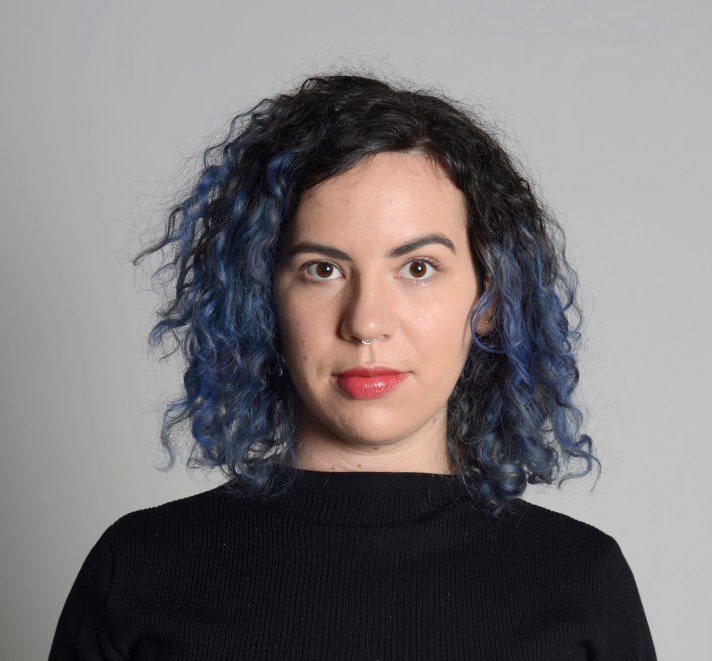
A headshot of a white femme-presenting person with shoulder length curly black and blue hair, wearing a black shirt, standing against a light gray background.

Caro Sinders, critical designer, machine-learning researcher, and artist with focus on critical data security and artificial intelligence; founder of Convocation Design + Research; with work featured at the Tate Modern, MoMA PS1, Wired, Slate, Hyperallergic, and others. 

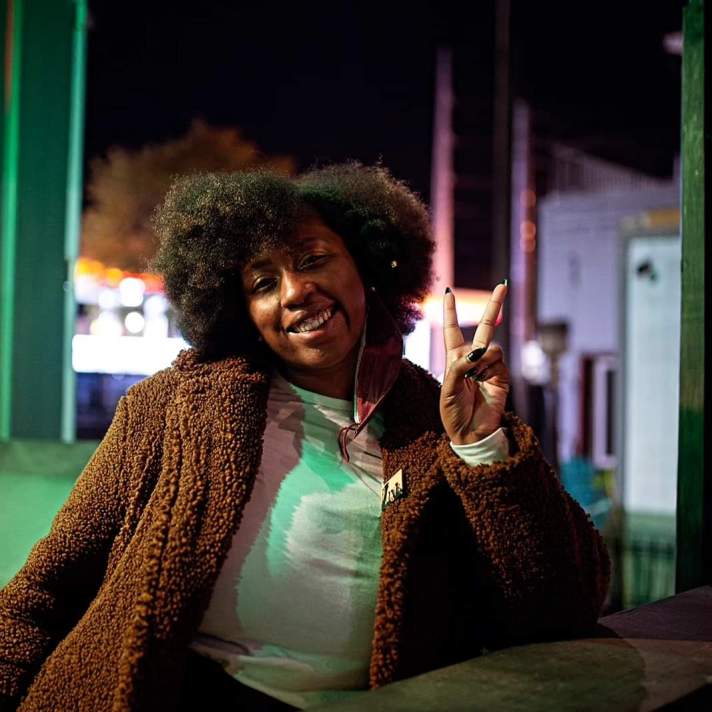
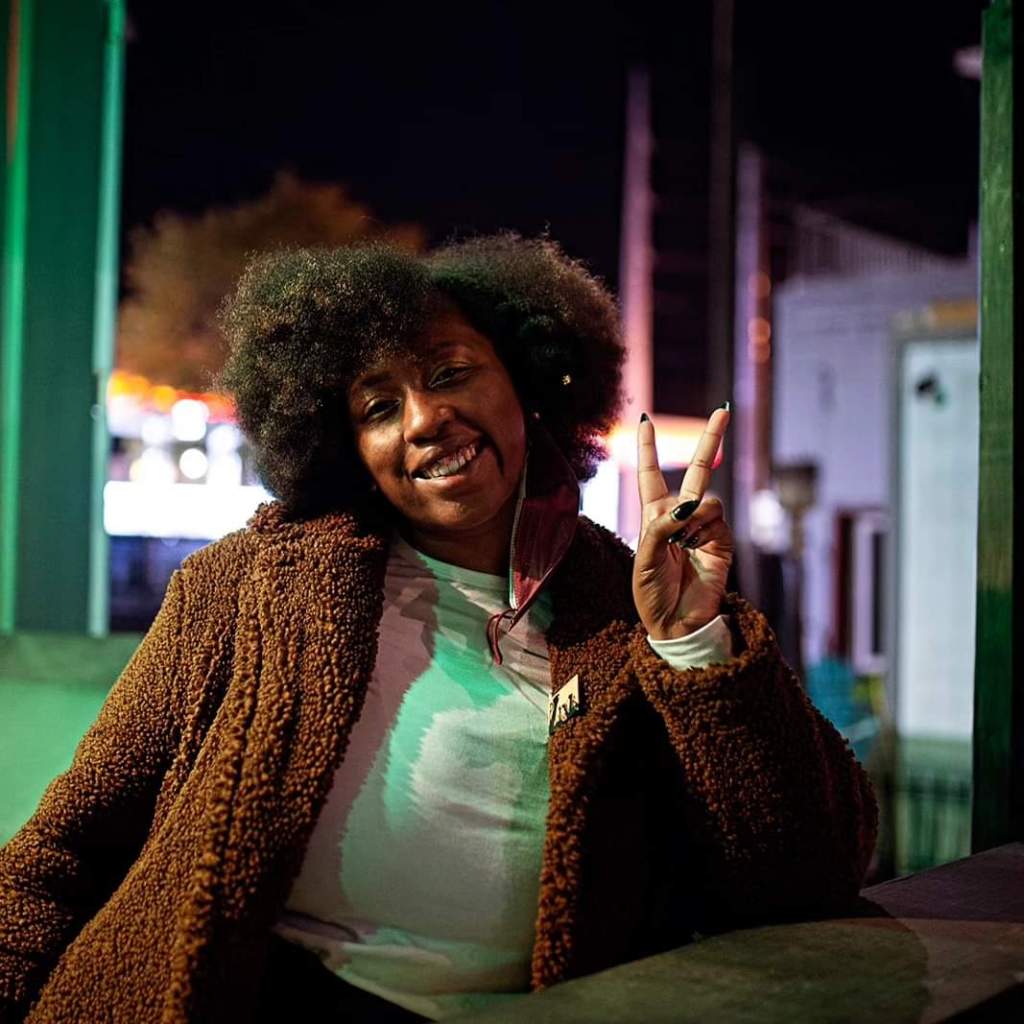
Photo of a brown skinned person leaning against a bar throwing up a peace signed with stiletto black and green nails. They are wearing a white shirt, a brown teddy bear coat with a yellow button and “power” in black letters in the shape of fists. This person has an afro with dark brown highlights, a side part and a singular twist with a gold clasp at the end. They are wearing a partially worn burgundy kn94 mask, taken off to reveal a smile.

Chelle Sands, Black queer feminist navigating the software and networking industry from a technoanimist lens, abolitionist cultural worker, network designer and herbalist

Finnegan posed next to a bright blue bench. Their handwriting on the bench reads, "I wish this city was more hospitable to my body's needs. Rest here if you agree." They are a boyish white person with a buzz cut. They are wearing a KF94 mask, a flouresent lime shirt, a floral fisherman-style vest.

Finnegan Shannon, artist whose recent work explores disability culture, belonging, and exclusion, including the Anti-Stairs Club Lounge, Alt-Text as Poetry, Do You Want Us Here or Not, and Don’t Mind If I Do.

Jen, an afro-latina disabled artist, wears a light blue shirt and a light brown straw hat, as well as wooden earrings featuring the Black power fist. She looks at the camera from the side.

Jen White-Johnson, Afro-Latina, disabled artist, designer, educator, and activist, whose visual work explores the intersection of content and caregiving with an emphasis on redesigning ableist visual culture; creator of the Black Disabled Lives Matter Logo and the Anti-Ableist Art Educators Manifesto; zine and collage-maker and cultural producer. 

Frequently Asked Questions

Who can participate? 

Applications for the Lab series are open to anyone who is training in creative and design fields, critical humanities and social science fields with an interest in disability, or organizing and activism. 

  • Design and other creative fields include architecture, urban design and planning, graphic design, industrial design, human-computer-interaction, visual arts, social practice, performance, coding, and others
  • Critical humanities and social science fields include critical disability studies, Black studies, science and technology studies, gender and sexuality studies, critical ethnic studies, American studies, media studies, Sociology, Anthropology, Educational Studies, and others
  • Activism, organizing, facilitation, and arts-based approaches to social change, with either an emphasis on disability justice and culture or wanting to learn more

This opportunity is directed at those “in training,” meaning students (undergraduate, graduate, or professional) or those without academic affiliations who are seeking a course of study (for example, in facilitator training, movement strategy and organizing, and other areas).

What is the time commitment for design lab participants? 

Participants should expect to spend approximately 6-7 hours per week on the summer institute, including 1.5-2 hours for the lecture (Mondays), 3 hours for the lab meetings (day decided by each lab), and 1-2 hours of homework time. 

How much does the institute cost?

The institute is free and comes with a stipend for your participation (if you are joining a lab).

What is required in order to get the stipend and certificate?

In order to get the certificate and stipend, you must confirm attendance at the lectures (synchronously or asynchronously), attend the lab meetings, and complete the assignments of your weekly lab meeting. We recognize that due to time zones, access needs, and other considerations, it may not be possible to attend every meeting in a synchronous manner. Each lab will work out the format for participation that works best for the members and particular projects.

What language will the summer school be in?

Our content will be in spoken English, with ASL interpretation and CART available.

What forms of accessibility will the Summer Institute offer?

The lecture series will have ASL interpretation and CART available. Lecturers will describe all images. The lectures will also be recorded so you can watch later if you’re not able to join at the time of the lecture. Lecture recordings will be captioned.

ASL and CART will be available for lab sessions upon request. Each lab will create an accessibility protocol for collaboration, design, information sharing, and communication.

When are applications due?

Applications are due by March 7, 2025. Click here to apply.

When will I know if I am accepted?

We will let you know by April 4, 2025.

Who can I contact if I have more questions?

Please contact Aimi Hamraie at aimi.hamraie@vanderbilt.edu if you have any questions.

Between Earth and Echo: Listening to the Lived Histories of Palestinian Landscapes

The Labs for Liberation fellows are exploring how ideas about disability and race can better inform how we think about design and technology. They will examine these intersections through blog posts throughout the year. In this year’s second blog post, Jumanah Abbas explores maps of Palestine, including controversies around mapping territory and the possibilities of multisensory mapping, including sonic mapping, for solidarity. 

Section one: Early Memories

When I was seven years old, we lived in At-Tira, Ramallah. Our apartment was a landmark in the neighborhood: a beige building with red rooftops, otherwise known as the lone wolf sitting at the end of the road, next to the abandoned police headquarters. Another iconic landmark, the police station, was destroyed in 2002 as a result of the ongoing Israeli aggression during the 2001-2003 Second Intifada. Both buildings stood in stark contrast to the backdrop of the occupied West Bank’s mountains and valleys, dotted with the indigenous flora and fauna of Palestine. 

The apartment was mid-rise level, while the police station was a two-level building, both overlooking the horizon and the mountains whose contours formed a strong silhouette and pierced the sky. One of my earliest memories of the landscapes surrounding Ramallah was observing these hinterlands. Adajnect were valleys and waters stretching into the distance. In the front, large green cars traveled across a road in the far mountains, usually during the afternoons and later into the evenings. Eventually, I realized those cars that I was seeing were Israeli military jeeps, and the roads were intended for settler-colonial use, cutting through the mountains and disrupting their natural ecologies.

On the night of the attack, the bombing of the police station, we were lucky not to be at the apartment. By lucky, I mean we were the unfortunate residents of a country that didn’t allow us to live on its land. As holders of an Irish passport, we had to travel to Jordan every 3 to 6 months to renew our residence. Our time in the West Bank was limited by the expiration of our ‘tourist visa permit,’ which was issued by the Israeli embassy. The constant back-and-forth trips were all-consuming: the rugged roads, thick with dust from the early construction of the apartheid walls and checkpoints, the sounds of  clamor-whether from the construction, or the orders of the Israeli soldiers against shuffling of the moving Palestinian bodies. These unsettling shaped my imagination of a landscape being cleared for surveillance walls and checkpoints soon to be built. 

As I look at the images of these landscapes, they are not lands to be analyzed and observed. They are also looking at their observers. These landscapes are not mere objects, they are sites of sharing lived experiences. They are not natural terrains to be drawn and calculated, they are witnesses to shared experiences and to histories of violence and survival. Therefore, to look at a map through the lens of the cartography is to question its veridicality. As the writer Jorge Louis Borge reflects in the Exactitude of Science about the map-territory relationship, maps reduce the representation of not only lands but also realities. These maps conform to the discipline of geography while neglecting the realities of access, disability justice, and those who are unable to claim rights to both. 

Section Two: Maps of Palestine

In the discovery of the hinterlands, images of idyllic valleys and rising hills lingered as a way of visualizing and imagining landscapes, with their romanticized notions often inherent in readings of land as idyllic and devoid of inhabitants. Settler-colonialism would transform these tools into means of erasure and oppression, as noted in the scholarly work of the architecture historian Nadi Abusada about the erasure of Jaffa’s city.

This realization only cements the idea that the production of oculocentric maps has been limited to scientific legends and Cartesian notions of spaces, as noted in the scholar-based work of Laura Krugen and Dara Barwley, as well as in the artistic-driven works of This is Not an Atlas. These maps are tools of coloniality—an enduring legacy that persists today in the form of Google Maps, GPS coordinates, and satellite imagery. Palestine has been mapped and remapped through a colonial gaze, which only permeates and enables those who can see maps to continue seeing them.

As we look back and move ahead with these new perspectives, how do we ensure the accessibility of these maps? One of the earliest examples is the Madaba Mosaic map, rendered in earthy tones, characterized by the extrusion of buildings and waves of brownish-beige used to map the surrounding terrain. A juxtaposition to this would be the latest developments in digital cartography, such as UNESCO maps, which represent advancements in technology but often fail to address the inequities and erasures inherent in their creation.

Section three: Controversies around mapping

If I can recall landscapes beyond my vision, what would I hear and what would I be able to listen to? These landscapes were a refuge to me.  For colonial powers, they were spaces to occupy and control.  As I recall the contours and topographic lines of the landscape surrounding my house: my memory is jaded, blurred by time. But I vividly remember the noise polluting the roads: the sounds of cars across rugged paths, the honks and grunts of frustration, and the cries of people against an apartheid wall about to be built.

 I, then, ask how to visualize these landscapes if seeing is not the only mode of mapping, but so is hearing and feeling. How, then, can we map landscapes when seeing is not the only way to know them. Tactile maps offer one solution, allowing users to engage with raised surfaces that reflect contours, roads, and valleys, while Braille labels provide essential context. Haptic technology, such as touchscreens with vibrations or wearable feedback devices, transforms maps into tools felt rather than seen. These innovations allow us to navigate landscapes with our hands, aligning maps with the lived experiences of those often excluded from traditional cartography.

By incorporating touch and movement into mapping, we can challenge the exclusionary nature of maps, reclaiming them as tools of accessibility and resistance. Maps, when designed to be listened to and felt, can tell stories beyond the visual, amplifying the voices and experiences of those erased from the land.

Section 04: New ways forward

Balancing visual readings of maps—two-dimensional tools—with visualization techniques that allow for multisensory engagement is critical. These questions shape my research as I delve into the fellowship scheme. In Listening to Images, Tina Campt describes a method of engaging with photography and archival documents, focusing on quotidian practices that “capture the sovereign gaze” and “refuse the very terms of the photographic situation.”
In a similar way to Tina’s framework, the maps and documents we gather around Palestine engage with the sonic registers of the landscapes, becoming attuned to sensory modalities often silenced by the state-colonial grammar of the archive. By listening closely to maps, this research aligns with emancipatory practices seeking to confront the violence of maps without simply reproducing it. There are different ways we can listen to and hear the maps of Palestinian territories through these techniques of haptic maps. 
Section 05: Sonic resistance

As I work towards these multisensory maps, I ask myself: what is the present soundscape of Palestine? What are the sonic elements of landscapes, and how do we amplify the sounds, chants, music, and conversations emitted from Palestinian bodies and spaces? How is sound used as a metaphor to decipher resistance and foster collective action that makes demands for justice audible? How do we invite others to hear and listen to these sounds of resistance in relation to maps?

These questions arise as I engage with these tools that enhance access and multi-senses, considering how soundscapes might help reclaim narratives that have been silenced. For instance, one example of a sonic memory to be visualized could be the sound of the explosion on the night the police station was bombed—had we been in Ramallah for longer than three months, we might have heard it in person. Sonic maps could include the echoing calls to prayer, the rhythmic chants of protests, or the quiet rustling of olive trees swaying in the wind. These vignettes, pieced together, would form an understanding of how we can both see and listen to maps. They could represent the resistance, pain, and resilience etched into the landscapes of Palestine.

By attending to these multisensory elements, we might begin to create maps that truly represent the lived experiences of those who call these landscapes home.

Sign up to receive email alerts when we post!

Meet our Fellows!

It is with great pleasure that we welcome to the team two postdoctoral fellows and four community fellows! Learn a bit more about them below and read their full bios over on our About page.

Postdoctoral Fellows

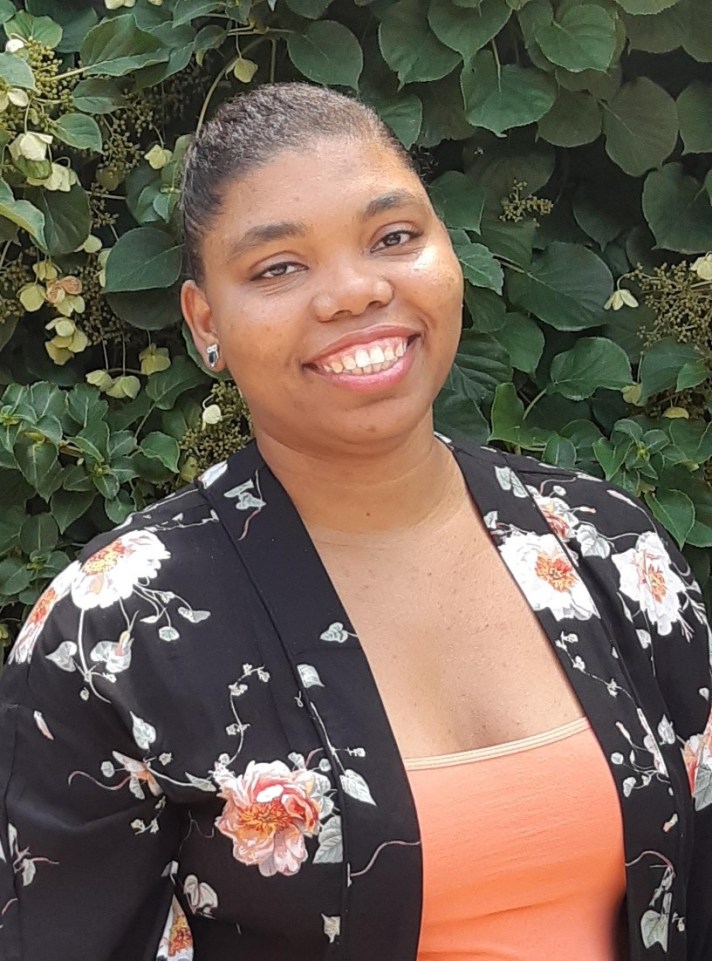
Photo of a brown skinned woman in front of a flowering plant. She is wearing a multicoloured floral shirt with a peach undershirt. She is facing the camera and smiling.


Angela Stanley (she/her)
Joining Team: Northwestern University
Favorite Snack: Plantain chips with mango sour
Zodiac Sign: Aquarius
Dominant Chinese Medicine Element: Earth
Theme Song or Personal Anthem: Constantly Changing!

A white woman smiles at the camera. She has blue eyes and dark brown hair tied up in a high bun, and she's wearing a black t-shirt with illegible blue and white text. She's kneeling in a grassy field next to a child, who is cut out of the frame, save for a white dinosaur-printed shirt.

LJ Jaffee (she/her)
Joining Team: Vanderbilt University
Favorite Snack: Sodium!
Zodiac Sign: Sagittarius
Dominant Chinese Medicine Element: Earth
Theme Song or Personal Anthem: 9 to 5, by Dolly Parton

Community Fellows

A black and white headshot of Jumanah Abbas wearing a white shirt and a grey head scarf and partially smiling at the camera. in an empty coffee shop.

Jumanah Abbas
Joining Team: Vanderbilt University
Favorite Snack: Banana and green tea/coffee
Zodiac Sign: Gemini
Dominant Chinese Medicine Element: Metal
Theme Song or Personal Anthem: Cavalry, by Mashrou Leila 

This image features a brown-skinned, non-binary person standing confidently in front of a vibrant stained-glass window. The lighting from the window casts a warm, almost halo-like glow behind them. They have long braids and are wearing a white t-shirt that prominently reads "PLEASURE" in bold black letters. The person has multiple necklaces, including one with a nameplate that says “dr. nick.” They are also wearing a smart watch and various rings, adding a stylish touch to their look. Their posture exudes confidence, and they appear calm and grounded. The stained-glass window in the background adds a spiritual, almost ethereal element to the photo. The overall vibe is both powerful and reflective, merging personal style with a sense of deep meaning.

dr. nick alder (they/themme/theirs)
Joining Team: Northwestern University
Favorite Snack: Deep River Sweet Maui Onion Chips
Zodiac Sign: Aquarius
Dominant Chinese Medicine Element: Water
Theme Song or Personal Anthem: Victory, by Janelle Monáe

Photo of a brown skinned person leaning against a bar throwing up a peace signed with stiletto black and green nails. They are wearing a white shirt, a brown teddy bear coat with a yellow button and “power” in black letters in the shape of fists. This person has an afro with dark brown highlights, a side part and a singular twist with a gold clasp at the end. They are wearing a partially worn burgundy kn94 mask, taken off to reveal a smile.

Chelle Sands (they/she)
Joining Team: Northwestern University
Favorite Snack: Ice cream!
Zodiac Sign: Aquarius
Dominant Chinese Medicine Element: Wood
Theme Song or Personal Anthem: Fig Tree by Bunny Wailer 

A headshot of a white femme-presenting person with shoulder length curly black and blue hair, wearing a black shirt, standing against a light gray background.

Caroline Sinders (they/them)
Joining Team: Vanderbilt University
Favorite Snack: White Cheddar Pop Corners, cheese grits and shrimp, and/or lemon icebox pie
Zodiac Sign: Sagittarius
Dominant Chinese Medicine Element: Metal
Theme Song or Personal Anthem: No rEgrets, by Aesop Rock / Deceptacon, by Le Tigre

Fellows will be joining their respective labs (Digital Apothecary at Northwestern and Critical Design Lab at Vanderbilt) and working on collaborative projects across both labs. Stay tuned for project updates and posts from our fellows over the coming months!

Sign up to receive email alerts when we post!

Access-Washing Genocide in Gaza

The Labs for Liberation fellows are exploring how ideas about disability and race can better inform how we think about design and technology. They will examine these intersections through blog posts throughout the year. In this year’s first blog post, LJ Jaffee explores the concept of “access-washing.” Access is usually considered the goal of disability rights and politics. But disability justice organizers, such as Stacey Park Milbern, have critiqued the way that the concept of “access” can also be used to justify violence against disabled and marginalized people. Access-washing is the first of many terms in “Critical Access Studies” that the fellows will explore.

I started grad school in 2014 at a university renowned for its disability studies program and disability rights history. My first semester coincided with the tenure of a new chancellor, and across campus, I was witnessing deepening ties to the military and defense contractors. Given that war is one of the greatest producers of disability globally, this struck me as paradoxical. I wanted language to make sense of my surroundings, but at that time, disability studies hardly engaged with feminist analyses of settler-colonialism, U.S. imperialism, and militarism (the work of Nirmala Erevelles and Jasbir Puar being notable exceptions). I started using “access-washing” to name this paradox.

The concept of access-washing has been useful for many disability scholars and activists because it names how access—the goal of disability rights—may sometimes be used to harm disabled people. This term is most often associated with the late disability justice activist Stacey Park Milbern, who described access-washing as “leveraging ‘accessibility’ as justification to harm communities of color and poor & working-class communities” (2019). Independently, I began using access-washing in 2017 to describe the deployment of accessibility rhetoric by settler states (and their institutions, like universities). Settler states, such as the U.S., Israel, Canada, and Australia, are sovereign nation-states politically dominated by migrant settlers rather than peoples indigenous to that land. My work shows that settler states rely on access-washing to repel criticism of their colonial violence and maintain control of stolen land. 

Access for Whom?

Access-washing, as an analytic lens, grew out of the work of disability justice organizers. Disability justice is an anti-capitalist framework theorized by U.S.-based queer and trans disabled folks of color. Disability justice is rooted in an understanding that disabled peoples’ experiences of the world and of ableism are shaped by the interplay of race, class, gender, sexuality, nationality, citizenship-status, and religion. Because capitalist states differentially recognize/value disabled people along these lines, disability justice organizers emphasize that securing civil and legal rights through the state— the focus of the disability rights movement in the U.S.— is a limited strategy that mostly works for disabled people with relative power. For example, undocumented disabled people cannot rely on the state to protect their disability rights because the state does not even recognize their right to exist within its borders. 

Drawing from the work of disability justice organizers, I use access-washing to “name the ways in which relatively privileged—often white, global Northern, cisgender—disabled groups are made hyper-visible to obscure structural forces that produce disability unevenly among populations, and particularly among the most marginalized disabled folks—Indigenous, Black, global South, trans” (Jaffee & Sheehi, 2024). This definition of access-washing complements and builds on Milbern’s definition by highlighting how accessibility is leveraged on a global scale. At the level of nation-states, access-washing can mask the power dynamic between occupied and occupier, colonized and colonizer, Indigenous and settler. 

The concept of access-washing builds on the work of queer organizers who coined the term “pinkwashing.” Pinkwashing describes the use of LGBT-friendly messaging by countries or companies as a public relations tactic. Naming pinkwashing challenges the way that gay rights are used to absolve nation-states of accountability for state violence (the use of force or oppression by states to subjugate people). For example, the Bay Area group Queers Undermining Israeli Terrorism (QUIT) used the term in 2010 to describe state-funded propaganda to market Israel as a haven for gays and lesbians, part of a strategy to brand itself as tolerant and cover up Israel’s violence against Palestinians. Because Israel is dependent on U.S. economic and political support, access-washing— like pink-washing— helps boost Israel’s projected image to a U.S audience as being “just like us” (that is, benevolent/modern/moral/civilized/democratic).

Focusing on U.S. higher education as a site for stabilizing U.S. empire, my research explores the shifting historical and economic conditions that gave way to access-washing, the implications of presuming access is a self-evident good (see Hamraie’s, Building Access), and what we can learn from anti-imperialist and decolonial movements that value collective access over a view of access as something granted to “worthy” individuals by the state. 

Access to What?

On World Autism Day, on April 2, 2024— one day after Israel killed 7 World Central Kitchen aid workers, when Israel had already killed an estimated 32,916 Palestinians and disabled untold numbers more— the organization Friends of the IDF (FIDF) tweeted, “FIDF’s Spectrum of Talent program is a trailblazer for inclusivity within the IDF. On #WorldAutismDay, we thank all soldiers for their courage, resolve, and dedication, with special acknowledgement to the power of talent and diversity.” The Israeli military is projecting an image as a leader in disability rights by advertising a program that grants Autistic Israelis access (here, to the military). What’s left out of the story is that disabled Israeli settlers’ access comes at the expense of Palestinians, who are systematically denied access to their own land (through Israel’s checkpoint system, apartheid walls, and ID system, among other means). Media coverage of Israel’s multiple programs for including Autistic Israelis in the IOF (Israeli Occupation Forces) consistently emphasizes Autistic soldiers’ visual-spatial perception as advantageous for analyzing drone footage and satellite images during Israeli incursions. Access-washing, here, reduces disability to a tactical advantage for land theft carried out by the military. In colonial contexts, access-washing is about land, and securing control of it.

The flip side of the hypervisibility of disability that access-washing creates in one instance is the invisibility of disability in another.  Through access-washing, the Israeli military is attempting to hide the disabling of Palestinians en masse as part of Israel’s genocidal land grab. The maiming/disabling of Palestinians is a longstanding colonial tactic to quash Palestinian resistance, as in Rabin’s “Broken Bones” policy directing the IOF to break the limbs of Palestinian protestors during the First Intifada. More recently, Israel’s access-washing attempts to cover up record amputations among Palestinian children in Gaza (many without anesthesia because of Israel’s blockade), a disabling polio outbreak precipitated by Israeli attacks on Gaza’s sanitation infrastructure, and targeted attacks on Palestinian healthcare workers and infrastructure that lay groundwork for rampant spread of disease.

The Antithesis of Disability Justice

Mainstream approaches to access within the global North treat states (or state institutions) as the granters of access, ignoring that settler states are founded on denying access (to land, paid labor, education, healthcare, etc.) to many. Access-washing builds on critical work by disabled writers and organizers who name the limits of a disability rights approach that appeals to nation-states to enable, facilitate, or protect access for disabled people (e.g., the late Marta Russell’s work on capitalism, disability, and the limits of civil rights legislation; Jen Deerinwater’s (Cherokee Nation) work on the impossibility of attaining justice through policy change under a settler regime that structurally disables Native peoples; Aimi Hamraie’s work critically historicizing the post-WWII national project that made white, middle-class veterans disabled by war politically legible under the pretense of “access for all;” and my work with co-author Kelsey Dayle John (Diné) insisting that decolonization demands some spaces be inaccessible to settlers, as settler conceptions of access can undermine Indigenous sovereignty). Like disability justice, the framework of access-washing challenges liberal notions of access in disability rights and disability studies that assume that with the right laws in place, the state will protect disabled people. Access-washing is a reminder that settler-capitalist states will only ever recognize some as people who could be worthy of access. As Milbern put it, “access-washing is the antithesis to disability justice.”

Further Reading/Listening

Ben-Moshe & Harris (2024). Pathologizing Palestinian Resistance. Death Panel Podcast.

Cowling, J. L. (2020). Occupied Land is an Access Issue: Interventions in Feminist

Disability Studies and Narratives of Indigenous Activism. Journal of Feminist Scholarship.

Jaffee & John (2018). Disabling Bodies of/and Land: Reframing Disability Justice in Conversation with Indigenous Theory and Activism. Disability and the Global South.

Jaffee & Sheehi (2024). Disrupting Fixity: Palestine as Central to Decolonial Disability Justice. Review of Disability Studies.

Milbern (2020). Notes on “Access Washing.” Disability Justice Network of Ontario.

Piepzna-Samarsinha, L. (2024). Palestine is Disabled. Disability Visibility Project.

Puar, J.  (2017). The Right to Maim. Duke University Press.

Russell, M. (2002). What Disability Civil Rights Cannot Do: Employment and political economy. Disability & Society.

Snounu, Smith, & Bishop (2019). Disability, the Politics of Maiming, and Higher Education in Palestine. Disability Studies Quarterly.

Sign up to receive email alerts when we post!

Summer 2024 Retreat

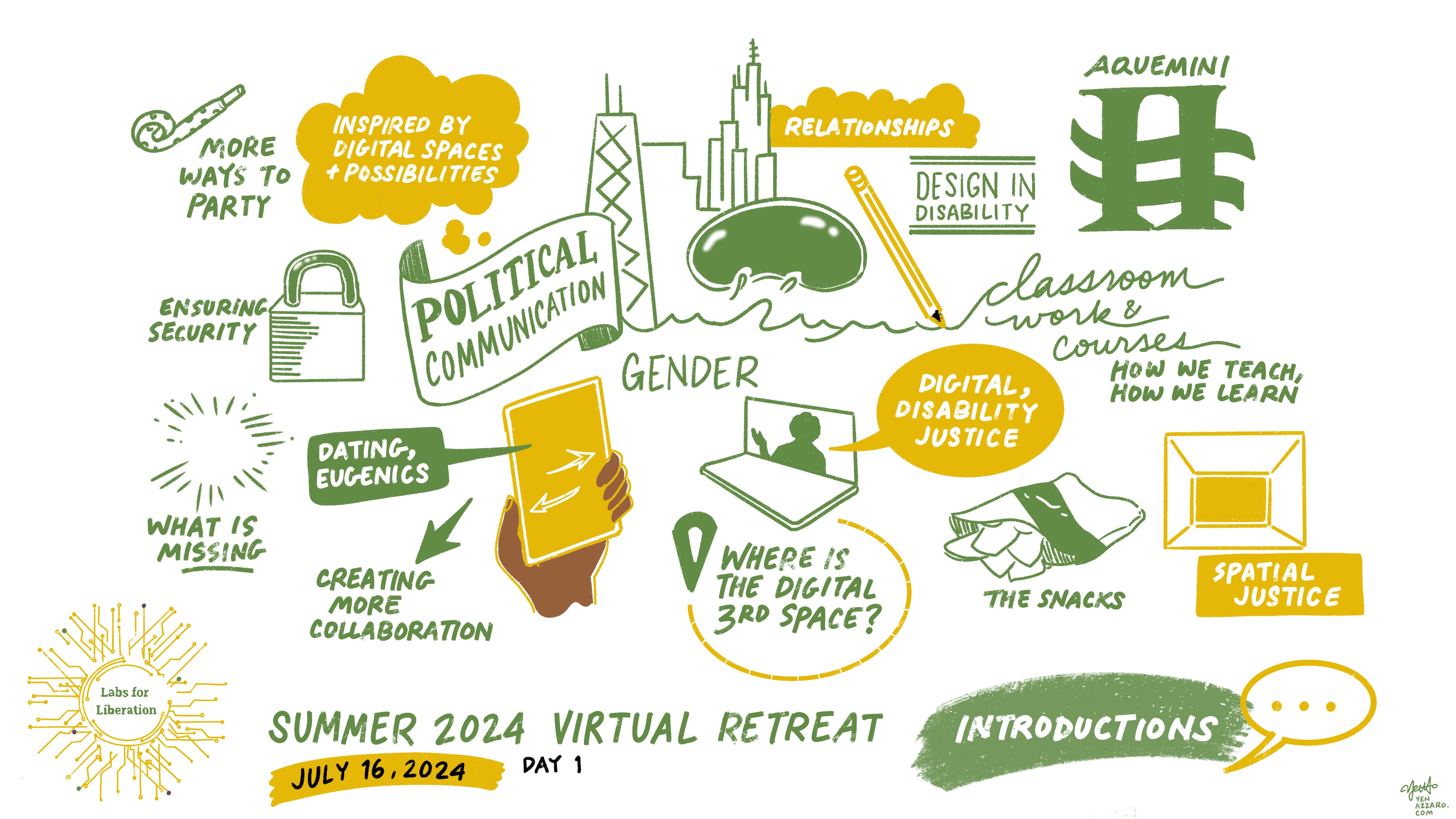
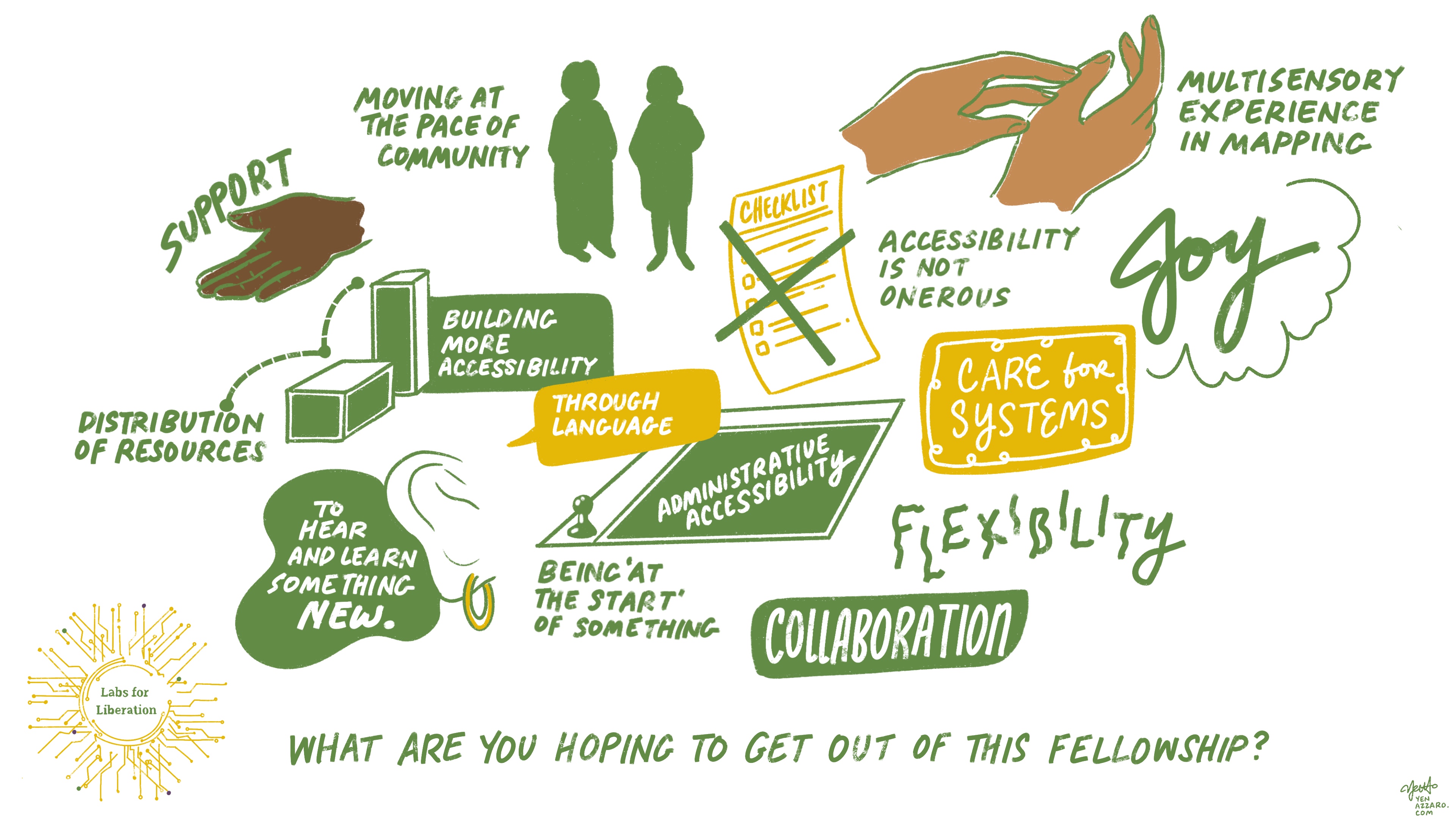
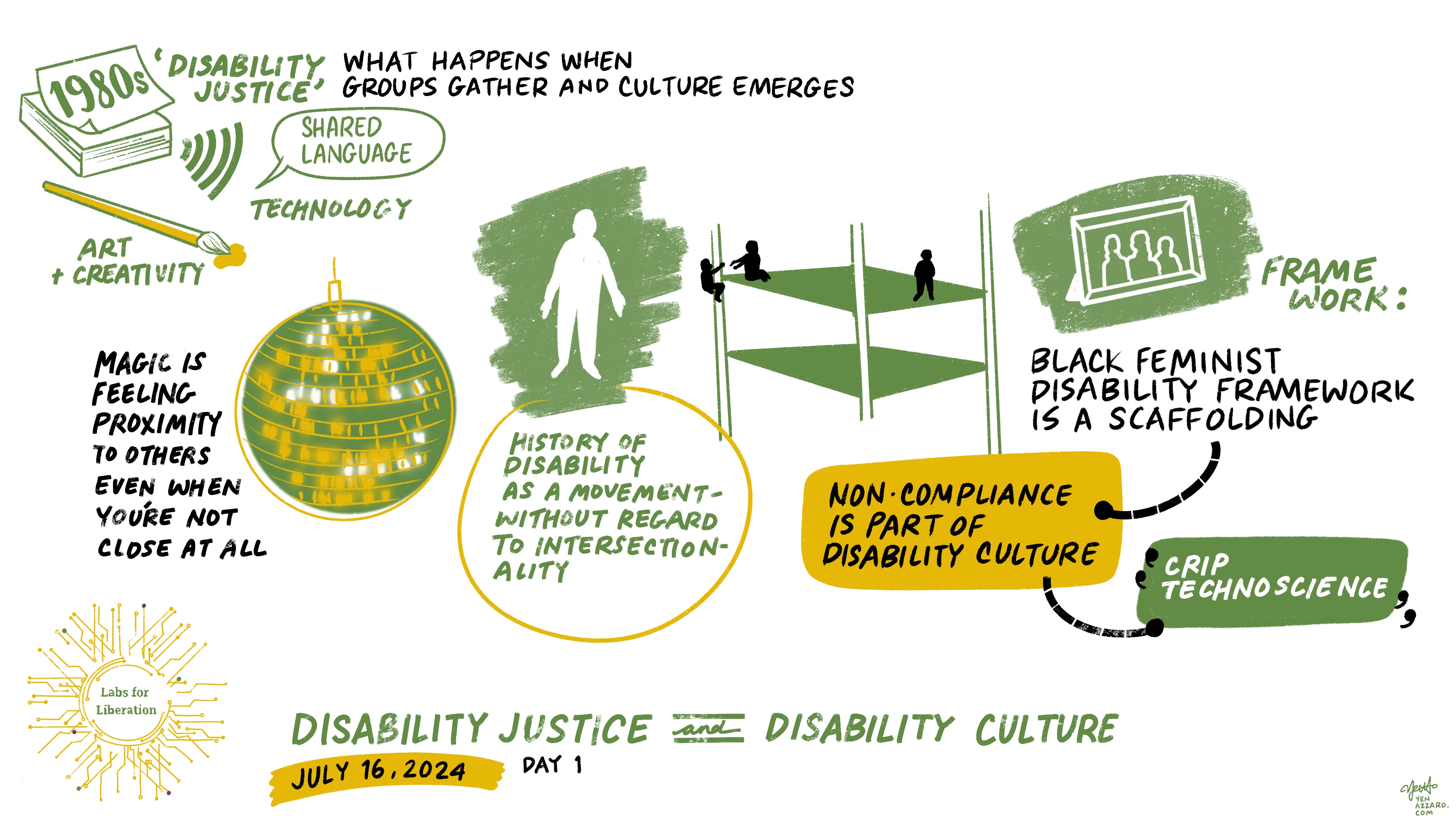
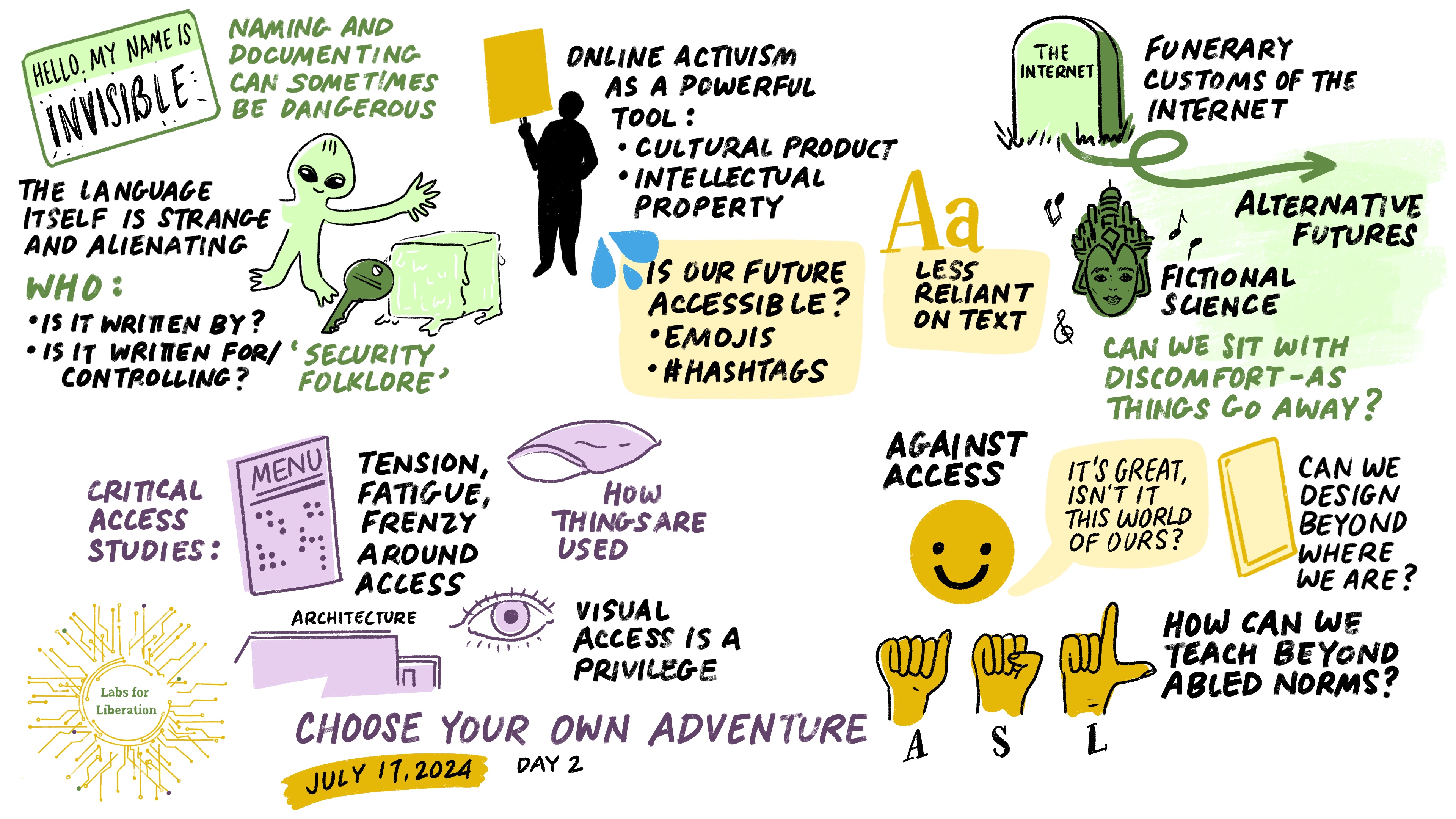
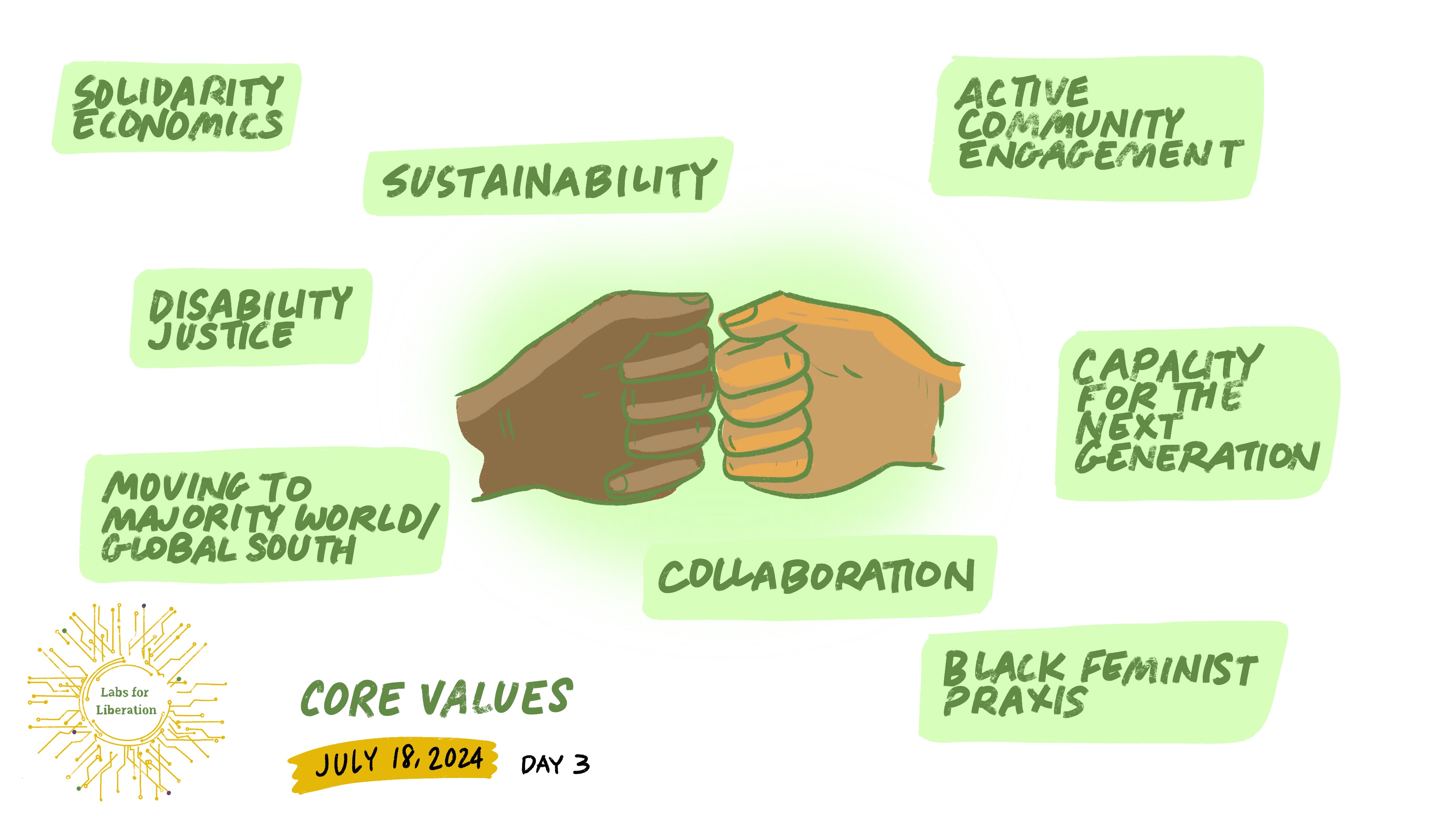
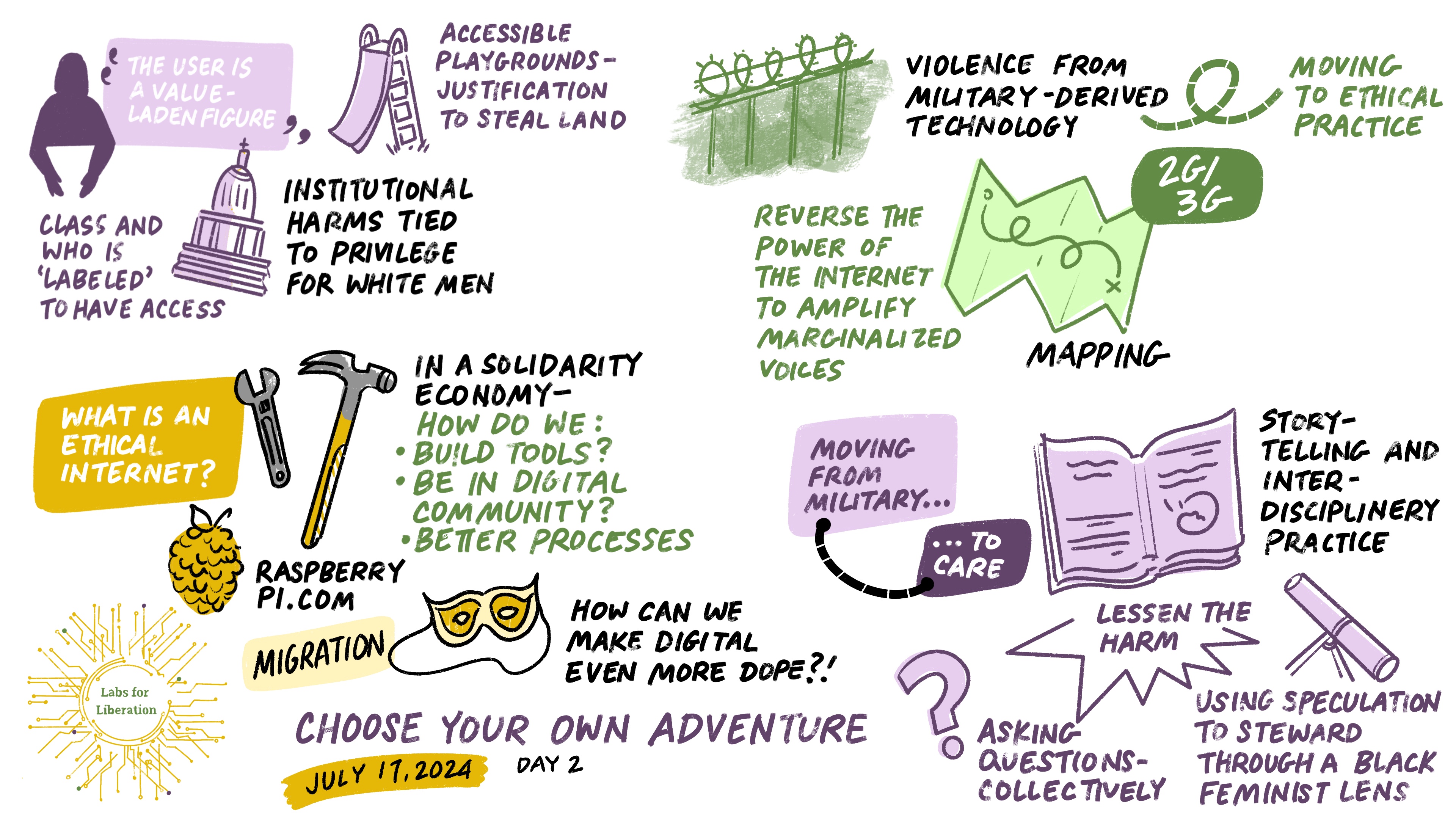
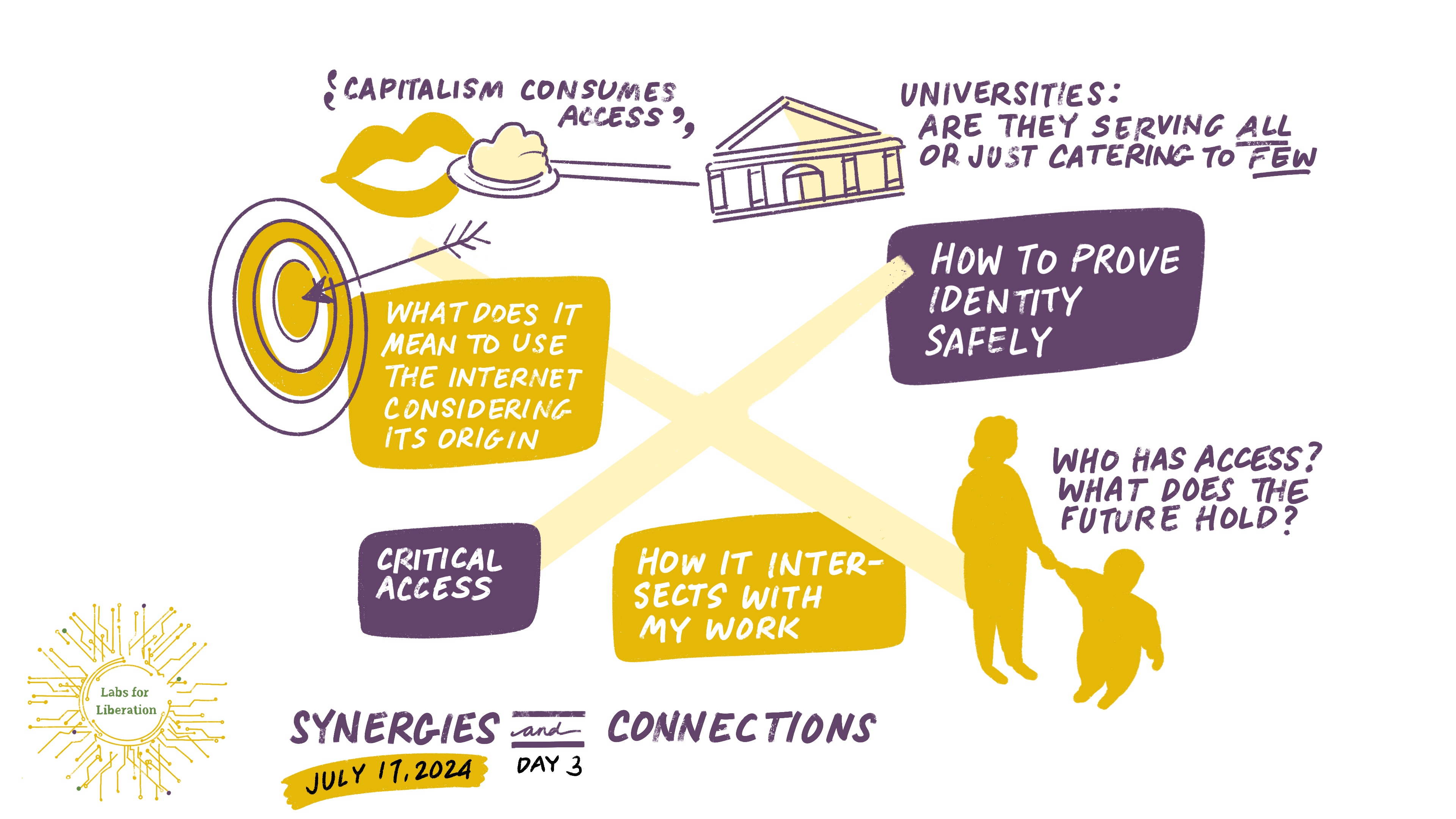
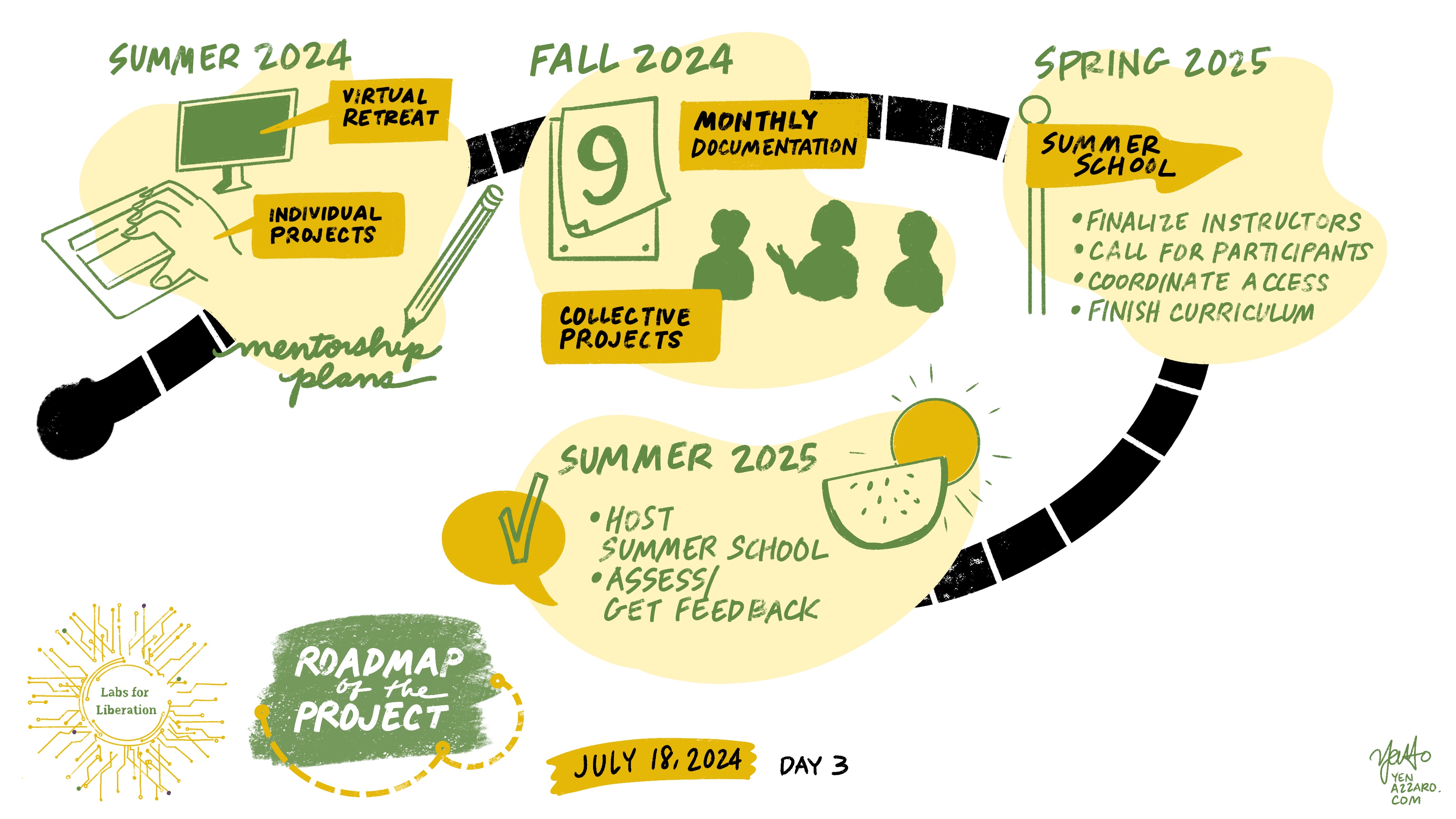
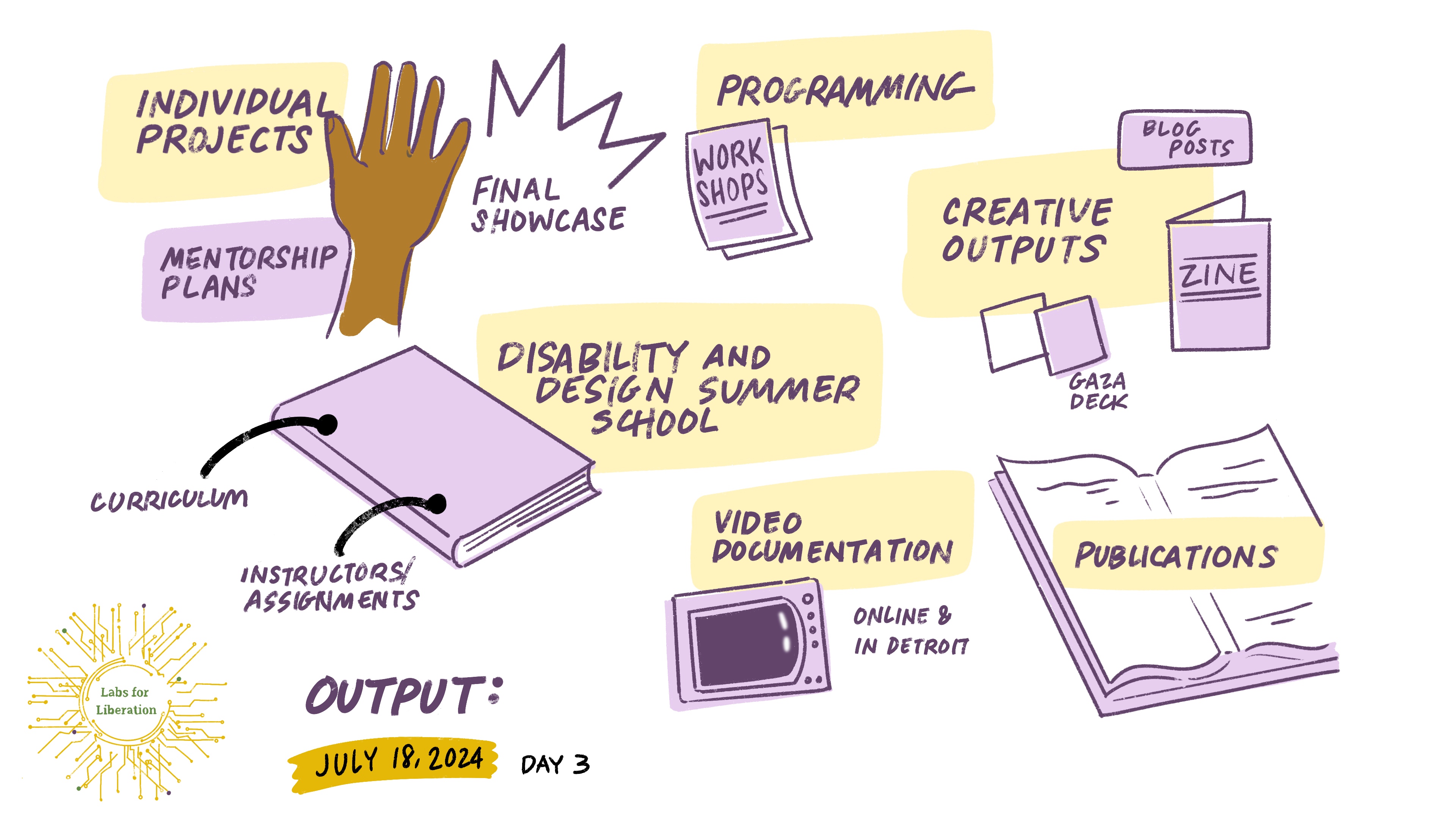
Over the summer we hosted a 3-day virtual retreat to get to know each other and set our intentions for the upcoming year. Yen Azarro graced us with her talented graphic recording/note-taking, and below are the images she shared with us.

Day 1: Who are we and why are we here?

Day 2: What are we interested in?

Day 3: Where are we placing our energies?

Sign up to receive email alerts when we post!

Greetings from Walker Brewer!

Hello! I am so excited to be working with the team on the Labs for Liberation project. I am a Ph.D. student in the School of Communications Media, Technology, and Society program at Northwestern University. My research bridges conversations between humanities-oriented theory from gender studies, disability studies, and literary studies with social science methodologies from communications, sociology, and media studies. Outside the academy, I am an amateur nail artist, a DIY/craft enthusiast, and an audiophile who spends most of my time listening to as much music as my ears can handle. I am always down to debate the best albums of the year while giving you a manicure and sitting on handmade quilted pillows.

The Labs for Liberation is a wonderful opportunity for me to collaborate with thoughtful thinkers within and outside the academy who are questioning and destabilizing how we approach pedagogy and design through the framework of Disability Justice. As a scholar equally invested in research and developing educational strategies that can transform the academy, I see Labs for Liberation as a productive site for institutional critique while providing a space to formulate speculative futures where collaboration and care become foundational practices. I am motivated by personal experiences with disability, inaccessible institutional structures, and normative understandings of identity to produce more inclusive and expansive educational practices.

As Katie mentioned, it is thrilling to think along such a varied network of scholars, tinkerers, and creatives on a project that centers marginalized voices in producing new pedagogical tools. I look forward to the engaging and productive conversations the lab continues developing!
Postdoctoral Position at Northwestern University with the Digital Apothecary

The Digital Apothecary seeks applications for a postdoctoral scholar position in the areas of critical disability studies, Black disability studies, and/or Black studies. This position begins in June 2024 and continues until August 2025. The ideal candidate is an interdisciplinary scholar who uses critical theoretical approaches to think through issues of Black studies, queer studies, and/or disability studies. Candidates will have strong skills in collaborative work, written communication, and project management. Experience with research-creation, design practice, media production, and related methods is preferred but not required. Interdisciplinary candidates completing PhDs (and/or PhD specializations) in fields such as Disability Studies, Gender and Sexuality Studies, Queer Studies, Black Feminist Health Science Studies, Science and Technology Studies, Digital Humanities, Design Studies, Black Studies, Ethnic Studies, and related fields are encouraged to apply. Candidates identifying with disability and disability communities are encouraged to apply.

This postdoctoral position is part of a collaborative project, Labs for Liberation, funded by the Mellon Foundation. Labs for Liberation brings together the Digital Apothecary with Vanderbilt University’s Critical Design Lab, directed by Dr. Aimi Hamarie. Labs for Liberation explores the laboratory form and structure as a space for integrating value-explicit research and research-creation, drawing from methods from disability culture and community organizing. Postdoctoral fellows will work collaboratively with members of both labs, including undergraduate and graduate students, postdoctoral fellows, and community fellows (including artists and community organizers). 

Responsibilities include:

  1. Carrying out a full-time active research program focusing primarily on critical disability studies, Black studies and related practices, including working on book and article manuscripts, solo publications, and/or collaborative publications with members of the Digital Apothecary. 
  2. Attending regular meetings of the Digital Apothecary and Labs for Liberation project teams. 
  3. Working collaboratively with Community Fellows to mentor graduate and undergraduate research on Labs for Liberation projects, including curriculum, podcasts, zines, and social media content.
  4. Helping to coordinate two summer institutes on disability and design (July 2024 and July 2025)
  5. Guest lecturing in courses related to disability studies and Black Studies

The Digital Apothecary is a hybrid digital and physical lab dedicated to combining ancient and new technologies in an effort to produce processes and projects that aid those most marginalized in society. It is a place for applied research that goes beyond theory. Projects include a system for ethical distribution of payment and investigations into the ethical internet. We are housed at Northwestern University, led by Dr. Moya Bailey, and powered by a collection of graduate and undergraduate students.

The postdoctoral fellow will be supervised by Dr. Moya Bailey (Associate Professor of Communication Studies). They will also work with Dr. Aimi Hamrie and the Labs for Liberation team at Vanderbilt University, which will also include a postdoctoral scholar and two community fellows. 

The one-year postdoctoral fellowship will begin on 6/1/2024 with an end date of 8/31/2025. The position carries a salary of $66,764, office/lab space, health insurance, and eligibility for other benefits (https://hr.northwestern.edu/benefits/postdoc-benefits.html). This is a full-time position that requires a physical presence in Chicago for the term of the fellowship. The postdoctoral fellow will also have access to an additional project budget, which reimburses allowable research expenses. 

To apply:

Applicants should provide a cover letter, a CV, and three references using this form [bit.ly/L4LDAP]. Cover letters should include information about candidate qualifications and research interests, interest in working with the Digital Apothecary and Labs for Liberation project, future research plans, and experiences with disability culture (if any). For full consideration, applications are due December 1, 2024. 

Link to Application

Northwestern University is committed to recruiting and retaining an academically and culturally diverse community of exceptional scholars. Women, minorities, and members of other underrepresented groups are encouraged to apply. Northwestern University is an Affirmative Action/Equal Opportunity employer. 

Mellon Community Fellowships in the Digital Apothecary

The Digital Apothecary (https://www.digitalapothecary.org) at Northwestern University directed by Dr. Moya Bailey is seeking two Community Fellows to work on a collaborative project, Labs for Liberation. Qualified candidates are activists, artists, designers, cultural workers, access workers, and community scholars who do not necessarily have a formal academic affiliation. We are specifically looking for candidates whose work addresses disability justice, design justice, Black liberation and racial justice, gender and sexuality liberation, or related areas, or who aspire to add these frameworks to their existing work. Fellows will have established skills in a relevant area, such as creative practice, community organizing, or app design. They may or may not have an art or design practice, but should be interested in working in a collaborative setting with others towards the goal of completing a specific project. Fellows with disabilities and experience with disability justice frameworks are encouraged to apply. This is a remote position. 

Community Fellows will be members of the Critical Design Lab, a multidisciplinary collaborative of disabled artists, designers, and design researchers. They will work with the Labs for Liberation team of researchers, postdoctoral fellows, community fellows, and students. Labs for Liberation is a collaborative project with Vanderbilt University’s Critical Design Lab (https://www.mapping-access.com/), directed by Dr. Aimi Hamraie. This project explores the “laboratory” form and structure as a space for integrating justice-centered frameworks into research and design. It is informed by methods from disability culture and community organizing. 

Compensation is $50,000 for a period between June 2024-August 2025. There is an additional project budget. The position is funded by the Mellon Foundation. 

Applications are due December 1, 2023. Interested candidates should note that there are also two positions in the Critical Design Lab. Please make sure that you are applying to the lab that you feel would be the best fit for you. 

Responsibilities 

Each community fellow will work on a collaborative project (“Labs for Liberation”) with the Digital Apothecary and Critical Design Labs. Over the school year, they will also:

  • Complete an independent project of their own design related to Labs for Liberation, with a personal project budget. They will receive mentorship from Hamraie, Bailey, and other team members.
  • Help organize and teach at two summer schools (June 2024 and June 2025). Summer school responsibilities include providing reading recommendations, helping to plan the syllabus, teaching daily sessions for the duration of the workshop, giving students feedback in small groups, and evaluating completed student work. 
  • Attend regular (remote) meetings with a collaborative cohort of postdoctoral fellows, student researchers, and other community fellows. 
  • Produce website content, such as blog posts, zines, and social media, to document their project. 
  • Present their project at an end-of-year event

How to apply 

Applications will be open on October 2, 2023 and will be considered until December 1, 2023. Interested candidates should submit application materials via this form [bit.ly/L4LDACF].

● A current CV or resume outlining your relevant background and experience

● A cover letter addressed to Dr. Moya Bailey, which describes: 

  • Why you want to work with the Digital Apothecary, including showing familiarity with the Lab’s work and stating why you think you would be a good fit; 
  • How this position fits into your professional, activist, or community goals; 
  • The values that inform your work or that you hope to learn to integrate through this fellowship;
  • A brief statement of the project you hope to complete during the fellowship year

● A work/art/project sample showing documentation of something you have completed in the past and are proud of. This could be a mini-portfolio, a short narrative, a gallery of images or videos, or something else. 

  • A project proposal (3-5 pages), which outlines the specific project goals, methods, timeline, and expected outcomes. 
  • A proposed budget for this project (see template). Imagine that you have $20-30,000 to carry out your project. How would you spend this money? 

● A list of three references that will be contacted should candidates progress through the application process. Please include names, email addresses, and a description of your relationship (such as “former collaborator,” “employer,” etc.)

Link to Application